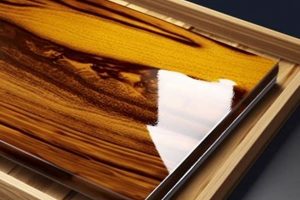
A surface treatment achieved by carefully charring the outer layers of lumber, results in a darkened, textured effect. This technique, sometimes referred to by its Japanese term “Shou Sugi Ban,” involves applying controlled fire to timber, altering its appearance and properties. For instance, cedar can be subjected to this process to enhance its natural grain and create a visually striking surface.
The application of intense heat offers several advantages, including increased resistance to fire, pests, and decay. Historically, this method provided a practical means of preserving wood in regions with limited access to modern preservatives. The resulting aesthetic also adds significant value, offering a unique and durable cladding or decorative element.
The subsequent sections will delve into the specific methods employed, the types of lumber best suited for this process, and the diverse applications this technique offers in contemporary design and construction. Furthermore, safety considerations and best practices will be addressed to ensure responsible and effective implementation.
Essential Considerations for Achieving a Charred Lumber Surface
The following guidelines outline critical aspects for successfully implementing a charred surface treatment, ensuring both aesthetic appeal and structural integrity.
Tip 1: Wood Selection is Paramount: Opt for softwoods like cedar, cypress, or pine, as they char more readily and exhibit pronounced grain patterns. Hardwoods can be used, but require significantly more heat and may not display the same degree of textural contrast.
Tip 2: Consistent Heat Application is Critical: Employ a propane torch or controlled fire source, maintaining a uniform distance and speed across the wood surface to ensure even charring. Uneven heat distribution leads to inconsistent results and potential structural weakening.
Tip 3: Control the Depth of the Char: The duration of heat exposure dictates the depth of the char. For exterior applications, a deeper char provides enhanced protection, while interior applications may require a shallower char for aesthetic purposes.
Tip 4: Quench the Char to Stabilize: Immediately after charring, extinguish the embers with water. This rapid cooling halts the burning process and prevents excessive material loss, stabilizing the charred layer.
Tip 5: Remove Loose Char Material: Utilize a wire brush to remove any loose or flaky char, revealing the underlying grain and creating a smooth, uniform surface. Failure to remove this debris compromises the integrity of the finish.
Tip 6: Apply a Protective Sealant: After brushing, apply a high-quality sealant or oil to protect the charred surface from the elements and prevent further degradation. The sealant also enhances the visual depth and richness of the charred wood.
Tip 7: Prioritize Safety Precautions: Always wear appropriate safety gear, including gloves, eye protection, and a respirator, when working with fire and charred materials. Conduct the process in a well-ventilated area to minimize exposure to smoke and fumes.
Tip 8: Consider Grain Orientation: Charring perpendicular to the grain provides a different visual effect than charring parallel to it. Experiment with different orientations to achieve the desired aesthetic.
Adhering to these principles will result in a durable, visually appealing surface treatment that enhances the longevity and aesthetic value of the lumber.
The subsequent analysis will explore the diverse applications of this surfacing technique in architectural design and furniture making.
1. Fire Resistance Enhancement

The application of a deliberate surface char to timber intrinsically enhances its fire-resistant properties. This phenomenon arises from the carbonized outer layer acting as a sacrificial barrier. In the event of a fire, this layer chars further, insulating the underlying wood and slowing the rate of combustion. This effect reduces the speed at which the fire spreads and delays the structural weakening of the timber. Fire Resistance Enhancement is one of the most benefit of this “burnt finish on wood”.
Historically, the practice of charring wood for structural members was prevalent in regions prone to wildfires. Examples include traditional Japanese architecture where charred cedar siding (Shou Sugi Ban) provided a degree of protection against windblown embers. Modern implementations can be seen in contemporary fire-resistant building materials where surface carbonization is employed as a component of a comprehensive fire safety strategy.
The degree of fire resistance achieved depends on factors such as the wood species, the depth of the char, and the presence of any additional fire-retardant coatings. While a charred surface will not render wood completely fireproof, it significantly increases the time it takes for the material to ignite and structurally fail. This enhanced resilience provides crucial extra time for evacuation and fire suppression efforts. Understanding this enhancement is of practical significance for informed material selection and structural design considerations.
2. Aesthetic Textural Variation

The deliberate alteration of wood surfaces through controlled combustion produces a wide spectrum of visual and tactile effects, collectively defined as Aesthetic Textural Variation. This variation stems from the differential burning of the wood grain, resulting in a unique and unpredictable surface character.
- Char Depth and Grain Emphasis
The depth to which the wood is charred directly influences the prominence of the grain. Shallow charring accentuates the natural grain patterns, creating subtle visual interest. Deeper charring, conversely, can create a more dramatic, undulating surface as softer parts of the wood burn away faster, leading to a three-dimensional effect.
- Color Palette Modulation
The process generates a range of colors from light browns to deep blacks, depending on the intensity and duration of the heat. This tonal variation introduces depth and complexity, offering designers a nuanced palette beyond the natural color of the wood. Selective charring techniques can be employed to create specific color gradients or patterns.
- Surface Tactility and Sensory Experience
The resulting surface can range from smooth and polished to rough and heavily textured. The charred layer offers a distinct tactile experience, providing a contrast to conventionally smooth wood surfaces. This can be further modified by brushing or sanding, allowing for precise control over the final texture.
- Unique Surface Character and Unpredictability
Each piece of wood reacts uniquely to the burning process due to variations in density, grain structure, and moisture content. This inherent unpredictability ensures that each treated surface possesses a distinct character, preventing uniformity and fostering a handcrafted aesthetic.
These facets, when integrated, contribute to a surface that is both visually appealing and texturally engaging. The degree of aesthetic variation achievable through controlled combustion renders it a valuable technique in architectural design, furniture making, and artistic applications, where a distinctive and organic aesthetic is desired.
3. Pest Deterrence Capacity

The application of intense heat to timber surfaces imparts an inherent resistance to infestation by various wood-boring insects and other destructive organisms. This enhancement, arising from the altered chemical composition of the charred layer, provides a degree of long-term protection against biological degradation.
- Creation of an Unsuitable Habitat
The carbonization process alters the wood’s composition, rendering it less palatable and nutritious for insects and fungi. The resulting surface lacks the readily accessible cellulose and sugars that these organisms require for sustenance. This transformation essentially deprives pests of a suitable food source and habitat.
- Reduced Moisture Absorption
Charring reduces the wood’s ability to absorb moisture. Many wood-boring insects thrive in damp environments where timber is more susceptible to decay. By minimizing moisture content, the charred layer inhibits the establishment and proliferation of these organisms.
- Physical Barrier Formation
The charred surface acts as a physical barrier that deters insects from penetrating the wood. The hardened, brittle layer makes it more difficult for insects to bore into the timber, preventing them from reaching the underlying, untreated wood.
- Release of Repellent Compounds
During the charring process, certain volatile organic compounds are released, some of which exhibit repellent properties against insects. While the long-term efficacy of these compounds may vary, their initial presence contributes to the overall pest deterrence capacity.
These facets, when considered collectively, illustrate the multifaceted nature of the pest-deterrent properties of heat-treated lumber. While not a complete substitute for chemical treatments in extreme environments, the charred surface provides a significant level of protection, contributing to the longevity and structural integrity of timber structures.
4. Surface Preservation Technique

The application of intense heat to timber, resulting in a charred exterior, functions as a surface preservation technique by fundamentally altering the wood’s outermost layers. The process induces carbonization, transforming the surface into a protective barrier against various degradation factors. This practice exploits the principle that a controlled burn can enhance the wood’s resilience and lifespan. The causal relationship is clear: the deliberate combustion of the surface directly leads to improved preservation characteristics. The importance of this technique lies in its ability to extend the service life of timber without relying on chemical preservatives, presenting an environmentally conscious alternative. For example, the traditional Japanese practice of Shou Sugi Ban, involving charred cedar siding, exemplifies this method. The resulting surface demonstrates enhanced resistance to weathering, insects, and fire, showcasing the practical significance of this preservation approach.
Further analysis reveals that the specific benefits derived from this surface treatment are multifaceted. The carbonized layer reduces the wood’s permeability, inhibiting moisture absorption, a key factor in fungal decay. The altered chemical composition of the surface also makes it less attractive to wood-boring insects, providing additional protection. In practical applications, the depth of charring can be adjusted to suit specific environmental conditions and desired aesthetic outcomes. For exterior applications exposed to harsh weather, a deeper char is typically preferred, while interior applications may prioritize a lighter char for aesthetic reasons. This adaptability underscores the versatility of the technique as a preservation method.
In conclusion, the “burnt finish on wood” represents a valuable surface preservation technique. The controlled application of heat alters the wood’s surface, providing a natural defense against decay, insects, and fire. While the effectiveness of this method depends on proper execution and environmental factors, it offers a durable and aesthetically pleasing solution for preserving timber structures. Challenges include achieving consistent charring and preventing excessive material loss during the process. Nonetheless, the “burnt finish on wood” technique aligns with broader sustainability goals, promoting the use of durable, naturally preserved materials in construction and design.
5. Durability Augmentation Process

The application of intense heat to timber, known as the process to give “burnt finish on wood”, fundamentally enhances its durability. This augmentation extends beyond mere aesthetic alteration, contributing to the material’s long-term structural integrity and resistance to environmental stressors.
- Structural Hardening of Surface Fibers
The controlled combustion causes a transformation of the wood’s surface fibers. This results in a hardened, carbonized layer that is more resistant to abrasion, impact, and physical damage than untreated wood. For instance, charred wood used in exterior cladding is better equipped to withstand the constant wear and tear from weather elements and physical contact.
- Reduced Moisture Absorption and Dimensional Stability
The “burnt finish on wood” process diminishes the wood’s capacity to absorb moisture. This reduction in moisture uptake directly contributes to increased dimensional stability, minimizing warping, cracking, and other forms of distortion that commonly affect untreated timber. Examples include charred wood used in decks or boardwalks where moisture exposure is high.
- Enhanced Resistance to Biological Degradation
The altered chemical composition of the charred surface inhibits the growth of decay-causing fungi and deters wood-boring insects. This enhanced resistance to biological degradation extends the lifespan of the wood, reducing the need for chemical preservatives and maintenance. A prime example of this benefit is Shou Sugi Ban, where charred cedar siding exhibits prolonged resistance to insect infestations.
- Increased Fire Resistance due to Carbonized Layer
The carbonized surface layer functions as a sacrificial barrier that slows the rate of combustion in the event of a fire. This increased fire resistance provides valuable time for evacuation and fire suppression, potentially mitigating damage. While not rendering the wood fireproof, this added layer of protection significantly enhances its overall durability.
These durability-enhancing facets, achieved through controlled combustion, collectively extend the service life of timber, demonstrating the practical benefits of the “burnt finish on wood” process. The resultant material exhibits enhanced resistance to physical damage, environmental degradation, and biological attack, making it a viable option for various structural and decorative applications.
Frequently Asked Questions
The following addresses common inquiries regarding the preparation, properties, and applications of timber subjected to intense heat treatment. These questions aim to provide clarity on the process and its implications.
Question 1: Is a charred surface fireproof?
A charred surface is not fireproof. However, the carbonized layer can act as a sacrificial barrier, slowing the rate of combustion and increasing the time it takes for the wood to ignite. This provides enhanced, but not absolute, fire resistance.
Question 2: Does the treatment weaken the wood?
If performed correctly, the treatment does not weaken the wood. The charring process primarily affects the surface layer. Excessive or uncontrolled burning can compromise structural integrity, necessitating careful monitoring.
Question 3: What types of wood are suitable for a charred finish?
Softwoods, such as cedar, cypress, and pine, are generally more suitable due to their lower density and pronounced grain patterns. Hardwoods can be used, but require higher heat and may not exhibit the same degree of textural contrast.
Question 4: Is maintenance required for charred surfaces?
While charred surfaces are relatively low-maintenance, periodic cleaning and resealing may be necessary to protect the charred layer from weathering and abrasion. The frequency of maintenance depends on environmental conditions and the sealant used.
Question 5: Is the charred surface treatment environmentally friendly?
The treatment can be considered environmentally friendly, as it provides a natural alternative to chemical preservatives. However, the environmental impact depends on the source of the wood and the disposal of any waste materials generated during the process.
Question 6: Can the charred surface treatment be applied to existing structures?
The charred surface treatment can be applied to existing structures, provided the underlying wood is structurally sound and free from decay. Proper preparation, including cleaning and surface preparation, is essential for successful application.
These responses offer a foundational understanding of key aspects related to this unique surface treatment. Accurate information is crucial for informed decision-making in construction and design.
The subsequent section will explore potential challenges and limitations associated with the process.
Burnt Finish on Wood
The preceding examination has elucidated the multifaceted nature of “burnt finish on wood,” encompassing its creation, attributes, and applications. From fire resistance enhancement to aesthetic textural variation and pest deterrence capacity, the technique presents a unique approach to wood preservation and design. The process requires careful execution, with wood selection, heat control, and safety precautions as paramount considerations.
The viability of “burnt finish on wood” as a sustainable and durable solution hinges on a commitment to informed practices. Further research into optimal charring techniques and sealant technologies remains essential. Architects, builders, and designers must critically evaluate the benefits and limitations within specific contexts to ensure responsible and effective implementation. The future potential lies in integrating this time-honored method with contemporary construction practices for resilient and aesthetically compelling structures.

![Buy Quality Finished Shelf Wood - [Your Brand] | Best Final Touch: Elevate Your Projects with Professional Finishing](https://bestfinaltouch.com/wp-content/uploads/2026/05/th-447-300x200.jpg "Buy Quality Finished Shelf Wood - [Your Brand] Best Final Touch: Elevate Your Projects with Professional Finishing")
![Buy Premium Walnut Finished Wood [Deals Inside] | Best Final Touch: Elevate Your Projects with Professional Finishing](https://bestfinaltouch.com/wp-content/uploads/2026/05/th-405-300x200.jpg "Buy Premium Walnut Finished Wood [Deals Inside] Best Final Touch: Elevate Your Projects with Professional Finishing")