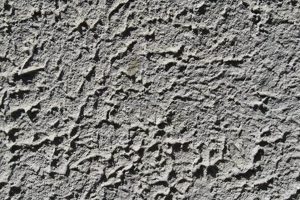
Instruments employed in the final stages of concrete placement, shaping, smoothing, and texturing the surface, are essential for achieving desired aesthetics and functionality. These implements range from simple hand tools like floats and trowels to power equipment, impacting the overall quality and durability of the finished concrete.
The use of appropriate implements contributes significantly to the longevity and performance of concrete structures. Proper finishing techniques ensure a level surface, prevent premature cracking, and enhance resistance to weathering and wear. Historically, advancements in this category have mirrored innovations in concrete technology, allowing for increasingly complex and refined finishes.
The following sections will delve into specific types, their applications, and best practices for achieving optimal results in various concrete finishing scenarios, discussing aspects such as hand operated instruments, power operated finishing instruments, and specialized options for decorative concrete.
Essential Considerations for Concrete Finishing Instruments
Effective utilization of implements designed for concrete finishing hinges on understanding material properties and employing proper techniques. The following recommendations are intended to enhance the quality and lifespan of finished concrete surfaces.
Tip 1: Surface Preparation: Prior to any finishing operation, ensure the concrete surface is free of debris, excess water, and bleed water. Inadequate preparation can lead to surface imperfections and reduced durability.
Tip 2: Timing is Crucial: Commencement of finishing activities must align with the concrete’s set time. Initiating too early can disrupt the cement hydration process; starting too late can render the surface unworkable.
Tip 3: Employ Proper Floatation: Use floats, such as bull floats or magnesium floats, to level the surface and embed aggregate. Over-floating can weaken the surface layer by bringing excessive fines to the top.
Tip 4: Trowel with Precision: Trowels, whether hand-held or power-driven, serve to create a smooth, dense surface. Avoid excessive troweling, which can result in discoloration and increased susceptibility to scaling.
Tip 5: Consider Environmental Factors: Ambient temperature, humidity, and wind speed significantly influence the concrete’s setting rate. Implement appropriate measures, such as windbreaks or evaporation retardants, to mitigate adverse effects.
Tip 6: Consistent Technique: Maintain uniform pressure and overlapping strokes when using any finishing implement. Inconsistent technique can lead to an uneven surface appearance.
Tip 7: Cleaning and Maintenance: Regularly clean finishing instruments to prevent concrete buildup, which can impair their performance. Store instruments properly to prolong their lifespan.
Tip 8: Safety First: Implement all necessary safety precautions, including the use of personal protective equipment (PPE), when operating power-driven finishing instruments. Adherence to safety protocols minimizes the risk of injury.
These guidelines offer a foundation for achieving professional-grade concrete finishes. Careful attention to these details translates to enhanced durability, aesthetics, and overall performance of the concrete structure.
The subsequent discussion will elaborate on advanced finishing techniques and specialized instruments that are suitable for particular applications, for example for decorative purpose.
1. Surface Smoothness

Surface smoothness in concrete finishing is a critical parameter directly influenced by the selection and application of appropriate implements. The attainment of a smooth, even plane affects not only aesthetic appeal but also the long-term performance characteristics of the concrete.
- Trowel Selection and Technique
The primary tools for achieving surface smoothness are trowels, available in various materials (steel, magnesium, composite) and sizes. The choice depends on the concrete mix, environmental conditions, and desired finish. Steel trowels, for instance, provide the highest level of smoothness but require precise timing and technique to avoid burning or discoloration. Power trowels further enhance smoothness over large areas, optimizing efficiency. The correct angle, pressure, and overlap of trowel strokes are essential to minimize imperfections.
- Timing and Concrete Hydration
The timing of the troweling process relative to the concrete’s hydration rate is paramount. Initiating too early disrupts the cement hydration, leading to bleed water and potential weakening of the surface. Commencing too late, when the concrete has hardened excessively, prevents effective smoothing. Experienced finishers monitor the concrete’s set and adjust their techniques accordingly. Evaporation retardants are often employed to extend the window of workability in adverse conditions.
- Influence of Aggregate Size and Distribution
The aggregate size and distribution within the concrete mix significantly influence surface smoothness. Mixes with larger aggregates require more effort to achieve a consistently smooth finish, potentially necessitating multiple troweling passes. Proper consolidation techniques, such as vibration, are crucial for ensuring uniform aggregate distribution and minimizing surface irregularities. The use of self-consolidating concrete (SCC) can reduce the need for vibration and improve overall surface smoothness.
- Impact on Durability and Maintenance
A smooth concrete surface enhances durability by reducing porosity and minimizing the ingress of water and deleterious substances. This is particularly important in environments exposed to freeze-thaw cycles or chemical attack. Smooth surfaces are also easier to clean and maintain, contributing to a longer service life. Applying sealers or coatings can further enhance the protective properties of a smooth concrete finish.
The relationship between implements and surface smoothness is therefore complex, demanding a thorough understanding of material science, proper timing, and skilled application. Skilled craftsmanship with suitable instruments leads to the desired smoothness, aesthetics, durability and reduced costs.
2. Durability Enhancement

The correlation between durability enhancement and concrete finishing instruments is significant. Proper finishing techniques, facilitated by appropriate implements, directly influence a concrete structure’s resistance to environmental degradation and wear.
- Surface Consolidation
Finishing implements, such as trowels and power floats, aid in consolidating the concrete surface. This process reduces porosity, minimizing water and chemical ingress, thereby enhancing resistance to freeze-thaw damage, chloride attack, and other forms of environmental degradation. Examples include bridge decks in cold climates, where surface consolidation significantly reduces deterioration caused by de-icing salts.
- Proper Curing
Finishing activities also prepare the concrete surface for effective curing. Curing compounds or water barriers, often applied directly after finishing, require a smooth, even surface to ensure uniform application. Adequate curing promotes proper cement hydration, leading to increased strength and reduced permeability. Improperly cured concrete is more susceptible to cracking and surface scaling. Post-finishing curing, with correct measures and tools, will enhance durability.
- Crack Prevention
Controlled jointing, often implemented during the finishing process, mitigates cracking due to shrinkage and thermal stresses. Grooving tools or saws are employed to create weakened planes in the concrete, encouraging cracks to form at predetermined locations. This prevents random cracking across the surface, which can compromise structural integrity and aesthetic appeal. Sidewalks and large concrete slabs benefit significantly from this method.
- Abrasion Resistance
Specific finishing techniques, such as the application of dry-shake hardeners and the use of specialized trowels, improve abrasion resistance. This is particularly important in areas subjected to heavy traffic, such as industrial floors and loading docks. The resulting surface is more resistant to wear and tear, extending the structure’s service life and minimizing maintenance requirements.
These aspects collectively demonstrate the direct influence of finishing instruments on concrete durability. Proper application of these implements, combined with appropriate finishing techniques, extends the lifespan of concrete structures and minimizes long-term maintenance costs. Skilled craftsmanship with suitable instruments leads to the desired abrasion resistance, crack prevention, curing, consolidation, aesthetics, durability and reduced costs.
3. Aggregate embedding
Aggregate embedding, a critical aspect of concrete finishing, is directly influenced by the selection and application of suitable implements. The primary goal of this process is to uniformly distribute coarse aggregate particles beneath the concrete surface, achieving both structural integrity and desired aesthetic outcomes. The implements used, such as floats (magnesium or wood), bull floats, and darbies, play a pivotal role in achieving optimal aggregate distribution.
The cause-and-effect relationship is straightforward: improper implements or techniques will result in uneven aggregate distribution, leading to surface irregularities, potential weaknesses, and a compromised finish. For instance, using a steel trowel too early in the finishing process can cause the aggregate to sink excessively, resulting in a surface with insufficient paste cover. Conversely, delaying the embedding process can render the surface too hard, making uniform aggregate distribution impossible. The importance of aggregate embedding lies in its contribution to a dense, durable surface resistant to abrasion and weathering. Exposed aggregate finishes, for example, rely entirely on proper aggregate embedding to reveal the desired texture and color, enhancing the aesthetic appeal of the structure. This is also supported by highway concrete. This ensures that the concrete is structurally sound and pleasing to the eye.
In summary, proper aggregate embedding is integral to achieving a structurally sound and aesthetically pleasing concrete finish. The selection and skillful application of specific tools are paramount in achieving the desired outcome, mitigating surface irregularities, enhancing durability, and ensuring the longevity of the concrete structure. Challenges arise from variations in concrete mix design, environmental conditions, and the skill level of the finisher. Success hinges on a thorough understanding of these factors and the appropriate selection and manipulation of aggregate and instruments during concrete finishing.
4. Leveling precision

The achievement of precise leveling in concrete surfaces is inextricably linked to the selection and skillful deployment of specialized instruments. Leveling precision, defined as the minimization of deviations from a specified horizontal or vertical plane, directly impacts the structural integrity, functionality, and aesthetic appeal of concrete construction. Instruments such as straightedges, laser levels, screeds, and bull floats are instrumental in establishing and maintaining this level. The cause-and-effect relationship is evident: inaccurate instrument calibration or improper technique results in uneven surfaces, leading to potential structural weaknesses, drainage issues, and compromised usability. For instance, a floor slab intended for industrial use requires a high degree of leveling precision to accommodate heavy machinery and prevent equipment malfunction.
The importance of leveling precision as a critical component stems from its direct influence on the performance and longevity of concrete structures. Consider a bridge deck: deviations from a level plane can lead to water accumulation, accelerating corrosion and compromising structural stability. Similarly, in residential construction, an unlevel foundation can result in uneven floors, causing doors and windows to malfunction and potentially affecting the building’s structural integrity. The practical application of this understanding manifests in the rigorous training and certification programs for concrete finishers, emphasizing proper instrument handling, calibration techniques, and the importance of consistent monitoring throughout the leveling process.
Achieving precise leveling presents several challenges, including variations in concrete mix consistency, environmental factors such as temperature and wind, and the limitations of human perception. Despite these challenges, the use of advanced technologies, such as laser-guided screeds and automated leveling systems, is continually improving the accuracy and efficiency of concrete leveling operations. These advancements underscore the ongoing efforts to mitigate potential errors and ensure that concrete structures meet the stringent requirements for flatness, levelness, and overall structural performance. Ultimately, leveling precision is not merely an aesthetic concern; it is a fundamental aspect of ensuring the safety, durability, and functionality of concrete infrastructure.
5. Textural variety

The attainment of textural variety in concrete surfaces is intrinsically linked to the application of specialized implements. A diverse range of finishes, from smooth, polished surfaces to rough, exposed aggregate textures, is achievable through the strategic utilization of specific instruments and techniques. This versatility allows concrete to serve both functional and aesthetic purposes across diverse architectural and construction applications.
- Stamped Concrete
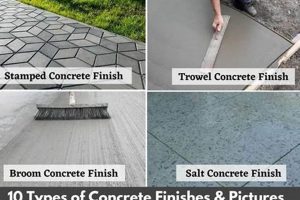
The creation of patterned surfaces through the use of texturing mats or stamps represents a significant facet of textural variety. These tools, often made of polyurethane or similar durable materials, imprint predetermined designs onto freshly placed concrete, replicating the appearance of brick, stone, or other materials. This technique allows for cost-effective aesthetic enhancements, transforming plain concrete into visually appealing surfaces suitable for patios, walkways, and driveways. The selection of appropriate stamps and release agents is crucial for achieving clear, consistent patterns without sticking or damage to the concrete.
- Broom Finishes
Broom finishes provide a slip-resistant texture, commonly employed in exterior applications such as sidewalks and driveways. The aggressiveness of the texture is controlled by the stiffness of the broom bristles and the timing of the brooming operation. A coarse broom creates a more pronounced texture, while a finer broom yields a smoother finish. This simple yet effective technique enhances safety by improving traction, particularly in wet or icy conditions. The direction and consistency of the broom strokes also contribute to the overall aesthetic appeal of the surface.
- Exposed Aggregate
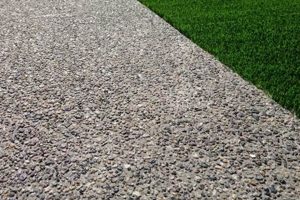
Exposed aggregate finishes reveal the natural beauty of the stone particles within the concrete mix. This is achieved by removing the surface layer of cement paste, typically through chemical retarders or manual washing, to expose the aggregate beneath. The size, color, and type of aggregate significantly influence the final appearance, allowing for a wide range of design possibilities. This technique is often used to create decorative walls, plazas, and architectural panels, showcasing the inherent texture and color variations of natural stone.
- Trowel Textures
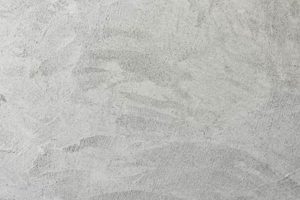
Trowel textures, created through intentional manipulation of the trowel during the finishing process, offer a subtle yet distinctive surface treatment. Techniques such as swirl finishes, knock-down textures, and hand-troweled patterns add visual interest and depth to concrete surfaces. The skill and experience of the finisher are paramount in achieving consistent and aesthetically pleasing results. This technique is commonly used in interior applications, such as walls and countertops, to create a unique and personalized look.
These diverse techniques, facilitated by specialized instruments, underscore the versatility of concrete as a construction material. The ability to manipulate surface texture allows for the creation of aesthetically pleasing and functionally appropriate finishes across a wide range of applications. Skilled craftsmanship, combined with the appropriate tools, unlocks the full potential of concrete as a design element.
6. Efficient operation
Efficient operation, in the context of concrete finishing, is directly contingent upon the selection, maintenance, and skillful application of appropriate implements. It signifies the minimization of time, effort, and material waste while achieving desired concrete surface characteristics. Suboptimal instrument selection or technique leads to increased labor costs, extended project timelines, and potentially compromised surface quality, ultimately impacting overall project profitability. The use of power trowels on large slabs, compared to manual troweling, demonstrates this efficiency principle by significantly reducing the time required to achieve a smooth, level finish.
Achieving efficient operation necessitates a comprehensive understanding of concrete mix design, environmental conditions, and the specific requirements of the finishing process. For example, utilizing lightweight magnesium floats on freshly placed concrete reduces the risk of surface tearing compared to heavier steel floats, allowing for earlier and more efficient commencement of the finishing process. Similarly, proper maintenance of finishing instruments, such as regular cleaning and blade sharpening, ensures optimal performance and minimizes the risk of equipment malfunction, preventing costly delays. The success of large-scale infrastructure projects hinges on efficient concrete finishing operations, emphasizing the need for well-trained personnel and meticulous planning.
In summary, efficient operation is a crucial component of concrete finishing, directly influencing project cost, schedule, and quality. It relies on the judicious selection, maintenance, and application of appropriate instruments, combined with a thorough understanding of the relevant factors. Challenges arise from variations in concrete properties, unpredictable weather conditions, and the inherent complexities of large-scale construction projects. Addressing these challenges requires continuous training, the adoption of advanced technologies, and a commitment to best practices, ensuring that concrete finishing operations are executed efficiently and effectively.
Frequently Asked Questions
This section addresses common inquiries regarding implements used in concrete finishing, providing clarity on selection, usage, and maintenance.
Question 1: What are the primary implements for concrete finishing, and what purpose does each serve?
Principal implements include floats, trowels, edgers, groovers, and brooms. Floats level the surface and embed aggregate. Trowels smooth and compact the surface. Edgers round edges to prevent chipping. Groovers create control joints to manage cracking. Brooms impart texture for slip resistance.
Question 2: How does one determine the appropriate implement based on the concrete mix and environmental conditions?
Concrete mix characteristics, such as aggregate size and slump, influence the choice of float. Higher slump mixes require more robust floats. Environmental conditions, like temperature and humidity, affect the setting rate, dictating the timing of troweling. High temperatures accelerate setting, requiring faster working implements.
Question 3: What are the essential maintenance procedures for concrete finishing implements?
Essential maintenance includes regular cleaning to remove hardened concrete, blade sharpening for trowels and edgers, and proper storage to prevent rust and damage. Cleaning solvents specifically designed for concrete removal are recommended.
Question 4: What safety precautions should be observed when using power-operated concrete finishing implements?
Safety precautions include wearing appropriate personal protective equipment (PPE), such as safety glasses, gloves, and hearing protection. Ensure equipment is properly grounded and inspected before use. Operate power equipment in well-ventilated areas.
Question 5: How does one achieve specific textures or finishes using concrete finishing implements?
Specific textures are achieved through specialized implements and techniques. Broom finishes are created using brooms of varying bristle stiffness. Exposed aggregate finishes require the removal of surface paste, often accomplished with chemical retarders. Stamped concrete utilizes textured mats to imprint patterns.
Question 6: What are common mistakes to avoid when using concrete finishing implements?
Common mistakes include over-troweling, which can lead to discoloration and scaling; improper timing, resulting in tearing or uneven surfaces; and inadequate cleaning of implements, causing buildup and reduced performance.
Mastering the selection, use, and maintenance of these implements is crucial for achieving durable and aesthetically pleasing concrete surfaces.
The next section will explore advanced techniques in concrete finishing and their respective uses.
Conclusion
This exploration has illuminated the indispensable role of implements employed in concrete finishing. From surface preparation to specialized texturing, the proper application of these instruments directly impacts the durability, functionality, and aesthetic qualities of finished concrete surfaces. Understanding the intricacies of each implement, from floats and trowels to specialized texturing tools, is paramount for achieving optimal results in diverse construction scenarios. Furthermore, adherence to best practices in maintenance and safety ensures both the longevity of the instruments themselves and the well-being of the user.
The informed selection and skillful application of concrete finisher tools represent a critical investment in the long-term performance and value of concrete structures. Continuous advancements in implement design and finishing techniques necessitate ongoing professional development within the concrete industry. A commitment to excellence in this domain will ultimately contribute to the construction of more durable, sustainable, and aesthetically pleasing infrastructure.