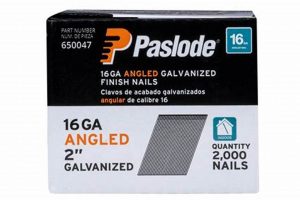
These fasteners, typically small-diameter and often featuring a brad or slightly countersunk head, are designed to provide a secure hold in exterior applications while minimizing visual impact. They are commonly employed where aesthetic considerations are paramount, such as installing trim, siding, or other decorative elements. Their design facilitates setting the nail head flush with or slightly below the surface, allowing for filling and painting to create an almost invisible fastening point.
The utilization of these specialized fasteners is crucial for achieving a professional, seamless appearance in construction and renovation projects. Their smaller size reduces the likelihood of splitting wood, particularly when working with delicate or thin materials. Furthermore, corrosion-resistant coatings or materials, such as stainless steel, are frequently incorporated to ensure longevity and prevent unsightly rust staining, crucial for exterior applications exposed to the elements. Historically, the need for unobtrusive yet durable fastening solutions led to the development of various types, each tailored for specific wood types and environmental conditions.
Understanding the properties and appropriate usage of these fasteners is essential for optimal results. The following sections will delve into specific material considerations, proper installation techniques, and best practices for ensuring long-lasting performance in outdoor environments.
Essential Usage Guidelines
Employing specialized fasteners correctly ensures both structural integrity and aesthetic appeal in exterior projects. These guidelines highlight critical aspects of their proper application.
Tip 1: Material Selection: Choose fasteners crafted from materials appropriate for the specific wood type and environmental conditions. Stainless steel or hot-dipped galvanized options are recommended for corrosion resistance in damp or coastal environments.
Tip 2: Correct Gauge Selection: Select the smallest gauge appropriate for the application’s holding power requirements. Overly large fasteners increase the risk of wood splitting, diminishing the aesthetic finish.
Tip 3: Consistent Spacing: Maintain uniform spacing between fasteners to distribute the load evenly and prevent stress concentrations that could lead to failure or warping of the material.
Tip 4: Proper Setting Technique: Utilize a nail set to drive the fastener head slightly below the surface of the wood. This allows for filling and painting without an unsightly protrusion. Avoid overdriving, which can damage the surrounding wood fibers.
Tip 5: Pre-Drilling in Hardwoods: When working with dense hardwoods, pre-drill pilot holes to prevent splitting and ensure easier fastener insertion. The pilot hole diameter should be slightly smaller than the fastener shank.
Tip 6: Avoid End Grain Fastening: Minimize driving fasteners directly into the end grain of wood, as this area offers minimal holding power and is prone to splitting. Whenever possible, fasten into the side grain for a more secure connection.
Tip 7: Consistent Depth Control: Utilize a pneumatic nailer with adjustable depth settings to ensure consistent fastener depth. This prevents both protruding fastener heads and excessive penetration, which can weaken the joint.
Adhering to these principles will maximize the effectiveness and longevity of exterior projects. The resulting finish will be both visually pleasing and structurally sound, capable of withstanding the elements for years to come.
The following sections will explore advanced techniques and address common challenges encountered during the installation process.
1. Corrosion Resistance

The performance of exterior finishing fasteners is intrinsically linked to their capacity to resist corrosion. Atmospheric exposure, particularly to moisture and pollutants, subjects these fasteners to conditions conducive to oxidation and subsequent material degradation. The resultant corrosion compromises the integrity of the connection, leading to potential structural weakness and aesthetic blemishes. An example is the rust staining that occurs when non-corrosion-resistant fasteners are used on light-colored siding, diminishing visual appeal and necessitating costly repairs. Therefore, corrosion resistance is not merely a desirable attribute but a fundamental requirement for exterior finishing fasteners to ensure longevity and structural soundness.
Several strategies are employed to enhance the corrosion resistance of these fasteners. Stainless steel alloys, due to their inherent chromium content, form a passive oxide layer that inhibits further corrosion. Hot-dipped galvanization, another common method, involves coating the fastener with a protective layer of zinc. Both processes significantly extend the lifespan of the fastener in exterior environments. Selecting the appropriate level of corrosion protection depends on the specific environmental conditions. Coastal regions, with their high salt content, demand more robust corrosion-resistant materials than drier, inland areas.
In summation, the consideration of corrosion resistance is paramount in the selection and application of exterior finishing fasteners. Neglecting this factor can lead to premature failure, compromising both the aesthetic quality and structural integrity of the project. A thorough understanding of the environmental conditions and the material properties of various corrosion-resistant fasteners is, therefore, essential for ensuring long-term performance and minimizing future maintenance requirements.
2. Gauge Selection

Gauge selection in the context of exterior finishing fasteners directly influences both the holding power and the aesthetic outcome of a project. The gauge, referring to the diameter of the fastener’s shank, determines its resistance to pull-out forces. A smaller gauge minimizes visual impact, a critical consideration for finishing applications, but it also reduces the fastener’s load-bearing capacity. Conversely, a larger gauge provides greater holding power but may detract from the desired seamless appearance. The balance between these conflicting requirements is crucial. For example, installing thin exterior trim might necessitate a smaller gauge to prevent splitting the wood and to minimize visible fastener heads, even if it means slightly reducing the overall strength of the connection. An incorrect gauge selection can manifest as either a structural failure, where the fastener is inadequate to withstand environmental stresses, or an aesthetic imperfection, where the fastener is overly conspicuous.
The relationship between gauge and material density is also significant. Softer woods generally require a larger gauge to achieve sufficient purchase, while denser hardwoods can accommodate smaller gauges without compromising holding power. Pre-drilling pilot holes, especially when using smaller gauges in hardwoods, can mitigate the risk of splitting and ensure proper fastener seating. A common application where gauge selection is paramount is the installation of siding. A fastener with insufficient gauge might fail to securely hold the siding in place during high winds or extreme temperature fluctuations, leading to warping or detachment. Choosing the appropriate gauge also involves considering the type of head, as different head types interact differently with the surrounding material, affecting both appearance and performance.
In conclusion, gauge selection is a critical component of achieving both a secure and aesthetically pleasing exterior finish. The optimal gauge is a function of material density, load requirements, and aesthetic considerations. A thorough understanding of these interdependencies is essential for selecting fasteners that provide long-term performance and visual harmony. Improper gauge selection can lead to structural failures, aesthetic imperfections, and ultimately, increased maintenance costs. Prioritizing informed gauge selection contributes significantly to the durability and beauty of exterior construction.
3. Head Type

The head type of an exterior finishing nail dictates its aesthetic impact and its functionality in securing materials. Different head designs serve specific purposes, influencing the fastener’s ability to be concealed and its resistance to pull-through. For instance, a brad head, characterized by its minimal size, is chosen when near-invisibility is paramount, allowing for easy filling and painting over the nail. In contrast, a countersunk head is designed to be driven flush with or slightly below the surface of the material, accommodating filling and providing a stronger, less prone-to-protrusion hold. The selection of head type is a direct determinant of the final appearance and long-term performance of the exterior finish. Consider the application of fine trim: a nail with an inappropriately large or visible head would detract from the intended elegance, necessitating a head type designed for concealment.
The practical application of different head types extends beyond mere aesthetics. Ring-shanked nails, often paired with countersunk heads, offer superior holding power in situations where material movement or expansion is anticipated. These nails resist backing out due to cyclical changes in temperature and humidity, common in exterior environments. The choice of head type also impacts the installation process. A flat head, for example, provides a larger surface area for the driving tool, reducing the likelihood of the tool slipping and damaging the surrounding material. Specific head types also lend themselves to different fastening methods. A clipped-head nail, common in pneumatic nailers, allows for a higher density of fasteners per strip, increasing efficiency but potentially compromising holding power compared to a full-round head.
In summary, the head type is an integral element of the exterior finishing nail, directly impacting both its visual profile and its mechanical performance. The selection process requires careful consideration of the aesthetic goals, the environmental conditions, and the specific material properties. An informed decision ensures a durable, visually appealing, and structurally sound exterior finish. Neglecting the importance of head type can lead to compromised aesthetics, reduced holding power, and increased maintenance requirements over time. The optimal head type is, therefore, a function of application-specific demands, and an understanding of the available options is crucial for successful exterior construction.
4. Material Compatibility
The selection of exterior finishing nails must consider the compatibility between the fastener’s material composition and the materials being joined. Incompatibility can instigate a range of adverse effects, including galvanic corrosion, discoloration, and structural weakening. Galvanic corrosion arises when dissimilar metals are in contact in the presence of an electrolyte (e.g., moisture), leading to accelerated corrosion of the more anodic metal. For example, using aluminum fasteners with copper flashing can result in rapid deterioration of the aluminum nail. This incompatibility not only undermines the integrity of the joint but also leads to unsightly corrosion products that stain surrounding surfaces. The significance of material compatibility is, therefore, not merely an abstract consideration but a practical necessity for ensuring long-term structural stability and aesthetic appeal.
Wood species also play a crucial role in determining suitable fastener materials. Certain woods, notably redwood and cedar, contain acidic extractives that can accelerate the corrosion of ferrous metals. Consequently, stainless steel or other corrosion-resistant fasteners are highly recommended for use with these wood types. Disregarding this consideration can result in premature fastener failure and subsequent deterioration of the surrounding wood. Furthermore, some woods react adversely to certain metals, leading to discoloration around the nail head. This phenomenon, often observed with iron-based fasteners in contact with tannin-rich woods, compromises the aesthetic integrity of the finished product. The understanding of these interactions is paramount for achieving lasting and visually pleasing results.
In conclusion, material compatibility is a critical determinant of the performance and longevity of exterior finishing nails. Careful consideration of the electrochemical properties of the fastener and the chemical composition of the materials being joined is essential for mitigating the risks of corrosion, discoloration, and structural failure. Adherence to best practices in material selection ensures a durable, aesthetically pleasing, and structurally sound exterior finish, minimizing long-term maintenance costs and maximizing the lifespan of the construction. The practical significance of this understanding lies in the prevention of preventable failures, safeguarding both the investment and the appearance of the project.
5. Proper Setting
The term “proper setting,” in the context of exterior finishing nails, denotes the precise and controlled insertion of the fastener to achieve both optimal holding power and a visually unobtrusive finish. It is a critical aspect of ensuring the longevity and aesthetic quality of exterior construction.
- Depth Control
Depth control refers to the consistent and accurate driving of the nail to a pre-determined depth. If the nail is set too deep, the surrounding material can be damaged, compromising its structural integrity and creating an unsightly depression. Conversely, if the nail is not set deep enough, it will protrude, detracting from the finish and potentially posing a safety hazard. Proper depth control, often achieved using a nail set or a pneumatic nailer with adjustable settings, ensures that the nail head is flush with or slightly below the surface, ready for filling and painting.
- Countersinking Technique
Countersinking is the deliberate act of setting the nail head slightly below the surface of the wood. This technique is particularly crucial in applications where the nail will be covered with filler and paint. The objective is to create a seamless transition between the nail and the surrounding material, resulting in a smooth and undetectable finish. The use of a nail set, a small metal punch, allows for the precise and controlled driving of the nail head without damaging the surrounding wood fibers. Failure to properly countersink results in visible nail heads that detract from the quality of the finish.
- Avoiding Overdriving
Overdriving occurs when the nail is driven too far into the material, causing the surrounding wood to compress and potentially split. This not only weakens the connection but also creates a visible blemish. Overdriving is often the result of excessive force or improper tool settings. Prevention requires careful technique, the use of appropriate tools, and a thorough understanding of the material being fastened. Avoiding overdriving is essential for maintaining the structural integrity and aesthetic appeal of the finished product. The negative effects of overdriving are difficult to remedy and often necessitate replacing the damaged material.
- Angle of Insertion
The angle at which the nail is driven into the material affects its holding power and its visibility. Ideally, the nail should be driven straight into the material at a 90-degree angle. Angled insertion can reduce the nail’s pull-out resistance and increase the likelihood of the nail head being visible. In certain applications, such as toe-nailing, angled insertion is unavoidable, but it should be executed with precision to minimize its negative effects. Maintaining a consistent and appropriate angle of insertion is a critical component of proper setting.
These facets collectively highlight the importance of precision and technique in achieving proper setting with exterior finishing nails. When correctly executed, proper setting ensures a durable, aesthetically pleasing, and structurally sound exterior finish that stands the test of time. Failure to attend to these details can lead to a compromised finish that necessitates costly repairs and detracts from the overall quality of the construction.
6. Wood Splitting
The phenomenon of wood splitting presents a significant challenge when utilizing exterior finishing nails, directly impacting the structural integrity and aesthetic quality of the completed work. The driving of a nail, particularly near the edge of a board or in denser wood species, exerts outward pressure that can exceed the tensile strength of the wood fibers. This results in a fracture, or split, that weakens the connection, compromises the intended visual appeal, and can ultimately lead to premature failure of the fastened components. The selection of appropriate nail gauges, pre-drilling techniques, and careful nail placement are all employed to mitigate the risk of wood splitting and ensure a lasting, visually seamless finish. For instance, using a thicker gauge nail in a delicate trim piece without pre-drilling is almost certain to result in splitting, necessitating repair or replacement of the damaged material. The interaction between the fastener and the wood’s inherent properties demands a nuanced understanding to prevent such occurrences.
Mitigation strategies center around reducing stress concentration and minimizing outward pressure. Pre-drilling pilot holes, slightly smaller than the nail shank diameter, creates a pathway for the fastener, reducing the force required for insertion and thereby minimizing the risk of splitting. Selecting a finer gauge nail also reduces the wedging effect. Additionally, positioning nails further from the edge of the board reduces the likelihood of creating a stress fracture that propagates along the grain. The choice of wood species further dictates the approach: denser hardwoods are more susceptible to splitting and require more careful pre-drilling and nail selection than softer woods like cedar or pine. Improper installation techniques, such as angled driving or excessive force, exacerbate the risk of splitting. The application of specialized adhesives in conjunction with nailing can also distribute stress and enhance the overall joint strength, further minimizing the chances of fracture.
In summary, the prevention of wood splitting is inextricably linked to the successful application of exterior finishing nails. Achieving a robust and aesthetically pleasing finish requires a comprehensive understanding of wood properties, appropriate nail selection, and meticulous installation techniques. Neglecting these considerations can lead to structural weakness, visual imperfections, and increased maintenance costs. Successfully mitigating the risk of wood splitting is, therefore, a cornerstone of quality exterior construction, ensuring both the durability and the visual appeal of the finished product. The integration of best practices, informed by a thorough understanding of the materials and methods involved, is essential for achieving optimal results.
Frequently Asked Questions about Exterior Finishing Nails
The following addresses common inquiries regarding the selection, application, and performance characteristics of these specialized fasteners. A clear understanding of these aspects is crucial for achieving optimal results in exterior construction and renovation projects.
Question 1: What distinguishes exterior finishing nails from other types of nails?
Exterior finishing nails are characterized by their smaller gauge, often featuring a brad or countersunk head designed for minimal visibility. They are also manufactured with corrosion-resistant materials or coatings to withstand the harsh conditions of outdoor environments. These features distinguish them from framing nails or general-purpose nails, which prioritize strength over aesthetic considerations.
Question 2: What factors influence the selection of the appropriate gauge?
Gauge selection is governed by the thickness and density of the material being fastened, as well as the desired level of holding power. Thicker materials may require larger gauges for adequate grip, while delicate materials necessitate smaller gauges to prevent splitting. A balance must be struck between strength and aesthetics to achieve the desired outcome.
Question 3: Why is corrosion resistance so critical for exterior applications?
Exterior environments expose fasteners to moisture, UV radiation, and pollutants that can accelerate corrosion. Corrosion compromises the structural integrity of the fastener, leading to potential failure and unsightly staining. Corrosion-resistant materials, such as stainless steel or hot-dipped galvanized steel, are essential for ensuring long-term performance and preventing premature degradation.
Question 4: How does pre-drilling mitigate the risk of wood splitting?
Pre-drilling creates a pilot hole that allows the nail to be inserted with less force, reducing the outward pressure exerted on the wood fibers. This is particularly important when working with dense hardwoods or near the edge of a board, where the risk of splitting is highest. The diameter of the pilot hole should be slightly smaller than the shank of the nail.
Question 5: What is the purpose of countersinking nail heads?
Countersinking involves driving the nail head slightly below the surface of the material. This allows for filling the resulting depression with wood filler or putty, creating a smooth and seamless surface that can be painted or stained. Countersinking is essential for achieving a professional-looking finish where the fastener is virtually invisible.
Question 6: What are the potential consequences of improper nail setting?
Improper nail setting can lead to several undesirable outcomes, including protruding nail heads that detract from the finish, damaged wood fibers due to overdriving, and reduced holding power due to insufficient penetration. Proper setting requires careful technique and the use of appropriate tools, such as a nail set or a pneumatic nailer with adjustable depth settings.
In conclusion, the informed selection and proper application of exterior finishing nails are paramount for achieving durable, aesthetically pleasing, and structurally sound results in exterior construction. Attention to detail and adherence to best practices are essential for maximizing the lifespan and minimizing maintenance requirements.
The next section explores case studies showcasing successful applications of these fasteners in various exterior projects.
Exterior Finishing Nails
This exploration has traversed the essential characteristics of exterior finishing nails, encompassing material selection, gauge considerations, head type variations, and proper installation techniques. The importance of corrosion resistance has been underscored, as has the necessity of mitigating wood splitting to ensure structural integrity. Furthermore, it has clarified the fundamental role these fasteners play in achieving both aesthetic excellence and long-term durability in exterior construction.
In light of the information presented, construction professionals and discerning homeowners should consider the multifaceted implications of fastener choice. A commitment to informed selection and meticulous application promises enhanced project longevity and sustained aesthetic value, while disregard of these principles may lead to compromised results and increased maintenance burdens. The responsible and knowledgeable use of exterior finishing nails is, therefore, paramount for successful and enduring exterior construction endeavors.