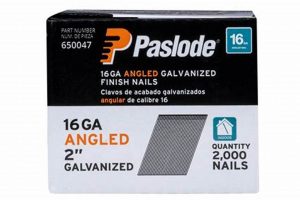
These slender fasteners, characterized by their small diameter and minimal head, are specifically designed to secure skirting boards to walls. Their primary function is to provide a near-invisible fixing point, allowing the trim to blend seamlessly with the wall surface. For example, they are used to attach a painted MDF board to a drywall surface, providing the necessary hold without detracting from the finished aesthetic.
The application of these fasteners ensures a clean and professional appearance in interior spaces. Their use prevents unsightly nail heads from being prominently visible, thus enhancing the overall design of a room. Historically, while various methods have been employed for attaching skirting, these fasteners have gained prevalence due to their ease of use and superior aesthetic outcome. The small head is easily concealed with filler and paint, resulting in a smooth, professional finish.
Therefore, understanding the appropriate selection criteria, proper installation techniques, and alternative fastening methods is crucial for achieving optimal results in baseboard installation. The following sections will delve into these essential aspects, providing a detailed guide for both novice and experienced installers.
Essential Installation Advice
The following recommendations provide a framework for achieving secure and aesthetically pleasing skirting board installations. Adherence to these guidelines can minimize common errors and ensure long-term stability.
Tip 1: Select the Correct Length: Ensure the fastener length is sufficient to penetrate both the baseboard and the wall stud behind the drywall. A fastener that is too short will not provide adequate holding power.
Tip 2: Utilize a Nail Set: Employ a nail set to drive the head slightly below the surface of the board. This allows for seamless filling and painting, concealing the fastener entirely.
Tip 3: Pre-Drill Hardwoods: When working with hardwood baseboards, pre-drilling pilot holes is essential. This prevents splitting of the wood during installation.
Tip 4: Stagger Nail Placement: Distribute fasteners evenly along the length of the board, staggering their placement to maximize holding strength and minimize stress concentration.
Tip 5: Use Appropriate Spacing: Space fasteners every 12-16 inches along the baseboard, increasing frequency near corners or areas subject to movement.
Tip 6: Consider Wall Material: Understand the wall material’s properties. Solid masonry walls necessitate different installation techniques, potentially requiring adhesive or specialized fasteners.
Tip 7: Fill Nail Holes Properly: Use a high-quality wood filler to conceal fastener holes. Allow the filler to dry completely before sanding smooth and painting.
Implementing these techniques ensures a professional and durable baseboard installation, contributing to the overall quality and aesthetic appeal of the interior space.
The concluding section will explore alternative methods and final considerations for achieving optimal results in any baseboard installation project.
1. Gauge

Gauge, referring to the diameter of the shank, is a crucial determinant in the performance and aesthetic outcome when utilizing fasteners for skirting board installation. The gauge influences both the holding power and the visibility of the fastener, requiring careful consideration during selection.
- Holding Power and Shear Strength
A smaller gauge provides less holding power than a larger one. Thicker fasteners resist bending and shear forces more effectively, which is vital for long-term stability, especially in areas prone to impact or movement. However, excessive gauge can lead to splitting in delicate baseboard materials, especially hardwoods.
- Aesthetic Impact and Concealment
A thinner gauge leaves a smaller hole, simplifying concealment. This is particularly pertinent when a seamless, paint-ready surface is desired. Finer gauge fasteners are less obtrusive and require less filler to achieve a smooth, professional finish. However, the trade-off is reduced holding strength, potentially requiring more frequent nail placement.
- Compatibility with Nail Guns
If utilizing a nail gun for installation, the gauge must correspond with the tool’s specifications. Incorrect gauge can lead to jamming, misfires, or damage to the tool. Most pneumatic nailers designed for trim work accept a limited range of gauges, typically between 15 and 18 gauge. This compatibility factor directly influences the speed and efficiency of the installation process.
- Material Considerations
The baseboard material also dictates the appropriate gauge. Softwoods like pine are more susceptible to splitting; therefore, a finer gauge is generally preferable. Hardwoods like oak require pre-drilling regardless, but a slightly larger gauge can be used without causing damage if pre-drilling is performed correctly. The density and grain of the baseboard material are key factors influencing gauge selection.
The interplay between holding power, aesthetic requirements, tool compatibility, and material considerations dictates the optimal gauge selection for fastening baseboards. A balanced approach, carefully weighing these factors, will contribute to both the structural integrity and the visual appeal of the installed trim. Selecting too small a gauge compromises stability, while an excessively large gauge detracts from the finish quality. Thus, careful evaluation is crucial.
2. Length

The length of a fastener directly influences the structural integrity and longevity of a baseboard installation. An inadequate length fails to achieve sufficient penetration into the wall stud or substrate, resulting in a weak hold prone to loosening over time. Conversely, excessive length can protrude through the wall, posing a safety hazard and creating an unsightly appearance on the adjacent side. The objective is to select a length that provides a secure anchor without causing unintended damage or aesthetic detriments.
Consider a scenario involving a -inch baseboard being installed against a drywall-covered stud wall. If the wall studs are 2×4 (3.5 inches actual depth), the fastener must penetrate a minimum of one inch into the stud for adequate holding power. Therefore, a fastener length of at least 2 inches (0.5 inch baseboard + 1.5 inches stud penetration) is necessary. If a shorter fastener is used, the baseboard might detach with minor impact. Alternatively, if a fastener that is too long is utilized, there is a potential that it can protrude out the other side of the wall where it can cause injuries to people.
Therefore, accurate measurement and a clear understanding of wall construction are indispensable. Neglecting to account for drywall thickness, stud depth, and the baseboard itself can compromise the entire installation. Precise calculation, coupled with appropriate length selection, forms the bedrock of a durable and aesthetically pleasing trim application.
3. Head Type

The configuration of the head on a fastener exerts a significant influence on both the aesthetic outcome and the functional performance of a baseboard installation. The head type dictates the ease of concealment, the degree of holding power, and the overall visual impact of the finished trim. Incorrect head selection can lead to unsightly installations requiring extensive remediation or, conversely, compromise the structural integrity of the baseboard attachment.
Consider the difference between a brad head and a countersunk head. A brad head, characterized by its minimal diameter, is designed for near-invisibility. It can be readily concealed with a small amount of filler and paint, resulting in a smooth, uninterrupted surface. However, the limited surface area of the brad head provides less holding power compared to other head types. A countersunk head, designed to be driven flush with or slightly below the wood surface, offers greater holding power but necessitates more extensive filling and sanding to achieve a seamless finish. The choice between these two head types hinges on a trade-off between aesthetics and functional strength. Another example includes pin heads, which provide an almost invisible hold, sacrificing strength for aesthetics. Ring shank nails, while not specific to the head, offer increased holding strength due to the ridged shank that grips the wood fibers, but their larger heads require more effort to conceal.
Effective baseboard installation necessitates a nuanced understanding of head type characteristics and their implications for both appearance and performance. Selection must align with the specific requirements of the project, factoring in the material of the baseboard, the desired aesthetic, and the anticipated stress on the trim. A well-informed decision regarding head type ensures a professional and enduring baseboard installation.
4. Material
The material composition of fasteners is a critical determinant of their suitability for baseboard installation. Corrosion resistance, strength, and compatibility with the baseboard material all dictate longevity and aesthetic outcome.
- Steel (Common Steel)
Common steel fasteners offer adequate strength for general interior applications, typically carbon steel. However, they are susceptible to corrosion, particularly in damp environments such as bathrooms or kitchens. Rust can stain the surrounding baseboard and compromise the fastener’s holding power over time. Therefore, bare steel fasteners are generally not recommended for long-term baseboard installations in moisture-prone areas, unless protected by paint.
- Galvanized Steel
Galvanization provides a protective zinc coating that significantly enhances corrosion resistance. Galvanized fasteners are more suitable for damp environments compared to common steel. However, the zinc coating can still degrade over time, especially if scratched or exposed to harsh chemicals. While offering improved protection, galvanized fasteners are not entirely impervious to corrosion and should be inspected periodically.
- Stainless Steel
Stainless steel represents the pinnacle of corrosion resistance in fastener materials. Its inherent chromium content forms a passive oxide layer that prevents rust, making it ideal for humid environments or applications where prolonged exposure to moisture is anticipated. Stainless steel fasteners maintain their strength and aesthetic appeal over extended periods, justifying their higher cost. An example of this is near a toilet or sink.
- Copper
Copper fasteners offer excellent corrosion resistance and a distinctive aesthetic. While less common for standard baseboard installations, copper fasteners are often used in specialized applications or when a decorative element is desired. Copper does not rust but can develop a patina over time, adding a unique character to the installation. It may also react with certain wood species.
Thus, the choice of fastener material must align with the environmental conditions and aesthetic preferences of the installation. Selecting an appropriate material ensures both the long-term integrity of the baseboard attachment and the visual harmony of the finished space. The additional cost of corrosion-resistant materials, such as stainless steel, represents a worthwhile investment in installations subject to moisture or demanding environmental conditions.
5. Placement
The strategic positioning of fasteners plays a pivotal role in the effectiveness and aesthetic outcome of any baseboard installation. Proper placement not only ensures secure attachment but also minimizes visual disruption and mitigates the risk of damage to the baseboard material.
- Spacing and Frequency
Consistent spacing along the length of the baseboard distributes stress evenly and prevents bowing or detachment. Standard practice dictates intervals of 12 to 16 inches, reducing to 6 to 8 inches near corners or joints where stress concentration is higher. Deviation from uniform spacing can compromise structural integrity and visual appeal.
- Proximity to Edges
Positioning fasteners too close to the top or bottom edge of the baseboard can induce splitting, particularly in brittle materials like MDF. A minimum margin of one inch is generally recommended to prevent edge failure. Careful measurement and precise application are essential to maintain structural integrity.
- Angled vs. Straight Nailing
Angled nailing, or toenailing, increases holding power by driving the fastener diagonally through the baseboard into the wall stud. This technique enhances resistance to pull-out forces. Straight nailing, while simpler, provides less resistance to lateral movement and is typically reserved for situations where studs are directly behind the baseboard.
- Stud Location and Alignment
Fasteners should ideally be driven into wall studs to achieve maximum holding power. The utilization of a stud finder to locate studs prior to installation is crucial. Failing to align fasteners with studs results in a weak attachment that relies solely on the drywall’s holding capacity, which is insufficient for long-term stability. Misalignment necessitates the use of alternative anchoring methods, such as drywall anchors.
Effective fastener placement is therefore not merely a mechanical task but an integral component of a well-executed baseboard installation. Adherence to established guidelines regarding spacing, edge proximity, nailing angle, and stud alignment ensures both the aesthetic appeal and the long-term durability of the finished product. Deviation from these principles can lead to compromised structural integrity and visual imperfections.
Frequently Asked Questions Regarding Fasteners for Skirting Board Attachment
The following section addresses common inquiries pertaining to the selection, application, and functionality of fasteners used in baseboard installation. These questions aim to clarify best practices and provide informed guidance for both novice and experienced installers.
Question 1: What type of fastener is most suitable for securing MDF baseboard to drywall?
Brad nails, typically 18 gauge, are recommended due to their small head size, which minimizes the visibility of the fastening point. The length should adequately penetrate the wall stud behind the drywall for secure attachment.
Question 2: Is it necessary to pre-drill pilot holes when installing baseboard with finishing fasteners?
Pre-drilling is advisable, particularly when working with hardwood baseboards. This practice reduces the risk of splitting the wood during installation and ensures a cleaner, more professional finish.
Question 3: What is the optimal spacing between fasteners when attaching baseboard to a wall?
A spacing of 12 to 16 inches is generally recommended along straight sections of the baseboard. Closer spacing, approximately 6 to 8 inches, is advisable near corners or joints where greater stability is required.
Question 4: Can adhesive be used in conjunction with fasteners for baseboard installation?
Yes, construction adhesive can supplement mechanical fastening, particularly on uneven walls or where stud access is limited. However, adhesive alone is not a substitute for mechanical fasteners.
Question 5: What should be done if a fastener bends over during installation?
The bent fastener should be removed and replaced with a new one. Attempting to straighten a bent fastener can weaken its structure and compromise its holding power.
Question 6: How should fastener holes be concealed for a seamless finish?
A high-quality wood filler should be used to fill the fastener holes. After the filler has dried completely, sand the area smooth and apply paint or finish to match the baseboard.
Proper fastener selection and installation techniques are essential for achieving a secure and aesthetically pleasing baseboard application. Consulting with experienced professionals or referring to detailed installation guides is recommended for complex projects.
The next segment will explore alternative fastening methods for baseboard installation, catering to specific scenarios or preferences.
Conclusion
The preceding exploration of “finishing nails for baseboard” has elucidated the critical parameters governing their selection and application. Gauge, length, head type, material, and placement each exert a distinct influence on the long-term performance and aesthetic quality of baseboard installations. A comprehensive understanding of these factors is paramount for achieving secure and visually appealing trim work.
Therefore, careful consideration of these factors is not merely a matter of preference but a prerequisite for durable and professional results. Mastering the nuances of “finishing nails for baseboard” empowers installers to execute projects with precision and confidence, ensuring lasting value and enhancing the overall quality of interior spaces. Continued diligence in refining these skills will undoubtedly contribute to superior craftsmanship in the field of finish carpentry.