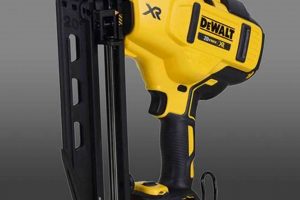
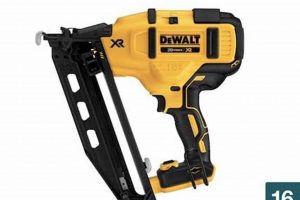
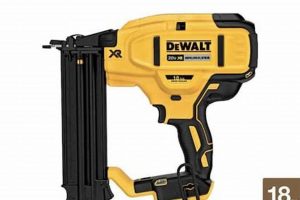
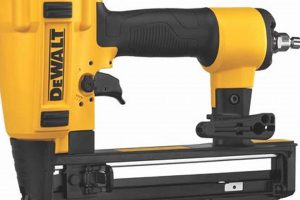
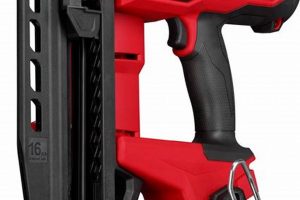
The terms denote two distinct types of pneumatic tools utilized for driving nails in woodworking and construction applications. One is designed for heavier-duty fastening, generally employing thicker gauge nails, whereas the other uses thinner gauge fasteners for more delicate tasks where concealing the nail head is paramount. Each possesses characteristics that make it suitable for specific applications.
Selection between the two depends greatly on the requirements of the task at hand. The former provides a stronger hold and is appropriate for structural elements or applications where the aesthetic finish is less critical. The latter offers a less conspicuous fastening point and minimizes the need for extensive filling and sanding, which is particularly beneficial in trim work and cabinetry. Historically, advancements in pneumatic technology have refined both tools, leading to increased precision, power, and ease of use.
The following sections will delve into a comparative analysis of these tools, examining their respective nail gauges, power capabilities, ideal applications, and factors to consider when choosing the appropriate one for a given project. A clear understanding of these differences is crucial for achieving optimal results and ensuring project longevity.
Tips for Selecting the Appropriate Tool
Optimal tool selection hinges on a careful evaluation of project needs. This section provides guidance to facilitate informed decisions regarding the use of each.
Tip 1: Assess Material Thickness: When working with thin materials, opt for the brad nailer to prevent splitting. Heavier materials, such as solid wood boards, may require the increased holding power of the alternative.
Tip 2: Evaluate Joint Strength Requirements: For structural joints or those bearing significant loads, the tool utilizing thicker gauge nails is generally preferable. Brad nails are better suited for securing trim or molding where minimal stress is anticipated.
Tip 3: Consider Aesthetic Concerns: If a seamless finish is desired with minimal visible nail heads, the brad nailer provides a distinct advantage. The smaller nail profile reduces the need for extensive filling and sanding.
Tip 4: Factor in Project Complexity: Intricate trim work and delicate assemblies benefit from the precision offered by brad nailers. Simpler, more robust projects can often be completed efficiently with the higher driving force.
Tip 5: Match Nail Length to Material Depth: Ensure the nail length is appropriate for the combined thickness of the materials being joined. Insufficient nail length can compromise joint integrity, while excessive length may result in protruding nail points.
Tip 6: Adjust Air Pressure Accordingly: Fine-tune the air pressure settings on the tool to match the density of the material. Too much pressure can cause nails to sink too deeply, while too little pressure may result in incomplete nail insertion.
Tip 7: Test on Scrap Material: Before commencing work on the final project, test the tool settings and nail selection on a piece of scrap material. This allows for adjustments to minimize the risk of damage or substandard results.
Selecting the correct tool, adjusting settings appropriately, and using the correct fastener length are essential for achieving professional and durable results. Understanding these factors contributes significantly to project success.
The subsequent section will explore specific applications and case studies to further illustrate the practical implications of choosing between the two.
1. Nail Gauge

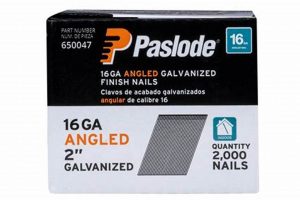
Nail gauge, a measure of nail thickness, constitutes a critical differentiator. A higher gauge number indicates a thinner nail. A finishing nailer commonly employs 15- or 16-gauge nails, providing significant holding power suitable for securing trim, baseboards, and crown molding where a robust fastening is needed. Conversely, a brad nailer utilizes 18-gauge nails, resulting in a smaller, less conspicuous hole. The selection of a brad nailer is often driven by the need for minimal visibility of the fastener, particularly in delicate woodworking projects or fine trim applications.
The direct impact of nail gauge manifests in several practical scenarios. For instance, when attaching thick hardwood trim around a door frame, a finishing nailer’s 15- or 16-gauge nail offers superior grip and resistance to pull-out compared to an 18-gauge brad. This increased holding power is crucial for maintaining the integrity of the trim over time, especially in environments subject to temperature and humidity fluctuations. However, in a different scenario, securing thin veneer to a substrate would necessitate a brad nailer. The thinner 18-gauge brad minimizes the risk of splitting the delicate veneer, preserving the aesthetic quality of the finished piece.
In summary, the relationship between nail gauge and the choice between a finishing nailer and a brad nailer is paramount. The appropriate selection hinges on a careful assessment of the material thickness, desired holding strength, and acceptable level of fastener visibility. Understanding the implications of nail gauge empowers informed decisions, ensuring that the selected tool aligns with the specific requirements of the project at hand. Inappropriate nail gauge selection can lead to structural weakness or aesthetic imperfections, highlighting the practical significance of this core distinction.
2. Head Size

Head size constitutes a crucial attribute differentiating finishing and brad nailers. Finishing nailers, employing nails with slightly larger heads, provide enhanced holding power. This larger head resists pull-through, particularly beneficial when securing heavier trim or materials prone to movement. Brad nailers utilize nails with significantly smaller heads, designed to be minimally visible. This smaller head profile reduces the need for extensive filling and sanding, advantageous in delicate woodworking or applications where aesthetics are paramount. The head size directly influences the fastener’s visibility and its capacity to resist withdrawal forces.
For instance, consider installing crown molding. A finishing nailers larger head provides greater surface area to clamp the molding against the wall or ceiling, ensuring a secure and lasting bond. The resulting nail holes, while slightly larger, are typically concealed with wood filler and paint. Conversely, when attaching thin decorative trim to a cabinet face, a brad nailer’s small head minimizes the visual impact of the fastener. The resulting smaller holes often require minimal filling, preserving the fine detail and smooth surface of the cabinetry. The selection between the two depends on a trade-off between holding strength and visual impact.
In summary, head size represents a critical consideration when choosing between a finishing nailer and a brad nailer. Smaller heads are essential when concealment is the primary goal, while larger heads provide superior holding power in applications requiring robust fastening. The appropriate selection directly impacts the final aesthetic and structural integrity of the project. Failure to account for head size can lead to either visually unappealing results or inadequate joint strength, underscoring its practical significance in woodworking and construction.
3. Holding Power

Holding power represents a primary differentiating factor between finishing and brad nailers. It describes the fastener’s resistance to withdrawal from the material into which it is driven. The difference in holding power between the tools stems primarily from variations in nail gauge and head size. Finishing nailers, employing thicker gauge nails and slightly larger heads, generally offer superior holding power compared to brad nailers. This attribute is crucial in applications where the joint is subject to significant stress or where long-term structural integrity is paramount. The cause-and-effect relationship is straightforward: increased nail diameter and head size result in greater frictional resistance and a larger surface area to counteract pull-out forces.
The implications of holding power are evident in various construction and woodworking scenarios. Securing thick baseboards to wall studs necessitates the use of a finishing nailer. The greater holding power ensures the baseboard remains firmly attached over time, resisting movement caused by temperature fluctuations or impact. Conversely, when attaching delicate trim or molding to a cabinet face, a brad nailer’s reduced holding power is often sufficient, while minimizing the risk of splitting the wood. Another practical example is furniture construction. Joining frame components typically requires the robust holding power of a finishing nailer, while attaching drawer bottoms or back panels may be adequately accomplished with a brad nailer. The tool choice directly impacts the long-term durability and structural integrity of the finished product.
In conclusion, the interplay between holding power and the selection between finishing and brad nailers is fundamental. A thorough understanding of the forces acting upon the joint and the material properties of the workpieces is essential for informed decision-making. While brad nailers excel in applications requiring minimal visibility and reduced risk of splitting, finishing nailers provide the necessary holding power for more demanding structural or high-stress applications. Neglecting this distinction can lead to compromised joint integrity, premature failure, and increased maintenance costs.
4. Application Versatility
Application versatility serves as a key differentiator when comparing finishing and brad nailers. The breadth of tasks each tool can effectively accomplish directly impacts its utility in various woodworking and construction scenarios. Understanding these variations in application versatility enables informed tool selection.
- Trim and Molding Installation
Finishing nailers excel in securing heavier trim and molding, such as baseboards and crown molding, where robust holding power is paramount. Brad nailers, conversely, are ideally suited for delicate trim work, including intricate molding and decorative accents, minimizing the risk of splitting and reducing the need for extensive filling.
- Cabinetry and Furniture Construction
In cabinetry, finishing nailers are often employed for assembling face frames and attaching cabinet sides, offering the necessary strength for structural components. Brad nailers find use in attaching drawer bottoms, cabinet backs, and other non-structural elements where a discreet fastener is desired.
- Paneling and Sheathing
Finishing nailers are suitable for attaching paneling to walls or ceilings, providing sufficient holding power to ensure secure attachment. Brad nailers may be used for thinner paneling or decorative overlays where minimal visibility is preferred and structural requirements are less demanding.
- Crafts and DIY Projects
Brad nailers offer versatility for a range of craft and DIY projects, including picture framing, model building, and small-scale woodworking. The lightweight design and minimal nail head size make them well-suited for intricate and delicate tasks where precision and aesthetics are critical.
The application versatility of finishing and brad nailers extends beyond these examples. The selection hinges on a careful evaluation of project requirements, including material thickness, holding power needs, and aesthetic considerations. A comprehensive understanding of each tool’s capabilities ensures optimal performance and professional results across a wide array of applications. The degree of application versatility is thus a vital aspect to consider when determining which tool best suits an individual’s or a professional’s needs.
5. Material Compatibility

Material compatibility represents a crucial consideration when selecting between a finishing nailer and a brad nailer. The tool chosen must be appropriate for the material’s density, thickness, and propensity to split. Incompatibility leads to compromised structural integrity or aesthetic imperfections. For example, driving a thick-gauge finishing nail into thin, brittle material, such as delicate trim or molding, often results in splitting or cracking. Conversely, using a thin brad nail in dense hardwood may provide insufficient holding power, leading to joint failure under stress. Material compatibility dictates the fastener’s ability to effectively join materials without causing damage or compromising long-term stability. The importance of material compatibility as a component is emphasized by observing these outcomes; optimal results are achieved when the fastener is properly matched to the material characteristics.
Practical applications demonstrate this principle vividly. When constructing cabinetry with solid hardwood face frames, a finishing nailer with appropriately sized nails is essential to ensure a secure and durable connection. Using brad nails in this scenario would likely result in a weak joint prone to loosening over time. However, when attaching thin veneer to a substrate, a brad nailer is necessary to prevent the veneer from splitting or bubbling. Likewise, when working with composite materials, such as MDF or particleboard, the risk of splitting is reduced, allowing for the use of either tool, albeit with careful consideration of nail length and gauge to prevent blow-out on the back side. The specific material dictates the appropriate course of action.
In summary, ensuring material compatibility is paramount when deciding between these tools. A misaligned fastener can undermine the project’s structural integrity or diminish its aesthetic value. The challenge lies in correctly assessing the material’s properties and selecting the appropriate nail gauge, length, and driving force. A thorough understanding of material compatibility is essential for achieving professional-quality results and ensuring long-term durability. The material properties directly influence the choice.
6. Tool Weight

Tool weight constitutes a significant ergonomic factor influencing user fatigue and maneuverability, thereby impacting the selection between a finishing nailer and a brad nailer. The tools vary in weight due to differences in construction materials, internal mechanisms, and intended power output. This distinction directly affects the ease and efficiency with which tasks are completed, particularly during extended use or in constrained workspaces.
- Material Composition and Construction
Finishing nailers, designed for more robust applications, often incorporate heavier materials, such as steel and reinforced polymers, to withstand higher driving forces and ensure durability. Brad nailers, intended for lighter-duty tasks, typically utilize lighter materials like aluminum and less dense plastics to minimize weight. This difference in material composition directly contributes to the disparity in overall tool weight.
- Internal Mechanisms and Power Source
The complexity and size of the internal pneumatic mechanisms also influence tool weight. Finishing nailers, requiring greater force to drive larger gauge nails, necessitate larger and more robust internal components. Brad nailers, operating at lower pressure and driving smaller fasteners, can employ simpler and lighter internal designs. The power source, whether pneumatic or cordless, also affects the overall weight profile, with cordless models often carrying additional weight due to the battery pack.
- Maneuverability and Accessibility
Lighter tools generally offer greater maneuverability, particularly in tight spaces or overhead applications. Brad nailers, typically lighter than finishing nailers, are advantageous when working on intricate trim details or in areas with limited access. The reduced weight minimizes user strain and allows for more precise nail placement, improving the overall quality of the finished product. The tradeoff is the tool will only accept smaller fasteners.
- User Fatigue and Productivity
Prolonged use of heavier tools can lead to increased user fatigue, potentially reducing productivity and increasing the risk of errors. Finishing nailers, often heavier than brad nailers, may require more frequent breaks or necessitate the use of ergonomic support devices. Selecting a lighter tool, such as a brad nailer, can mitigate these issues, improving user comfort and maintaining consistent work quality over extended periods. This is especially true in larger projects that require long periods of fastening.
In summary, tool weight represents a critical ergonomic consideration in the selection between a finishing nailer and a brad nailer. The choice should be based on a careful evaluation of task requirements, material properties, and user capabilities. While finishing nailers provide the necessary power for demanding applications, the lighter weight of brad nailers enhances maneuverability and reduces user fatigue in less strenuous tasks. A balanced approach, considering both tool weight and application demands, ensures optimal performance and user satisfaction.
7. Concealment Ability
Concealment ability, the degree to which a fastener is hidden from view after installation, is a primary determinant in the selection between a finishing nailer and a brad nailer. This attribute impacts the final aesthetic of woodworking and construction projects. Minimizing fastener visibility reduces the need for filling and sanding, thereby streamlining the finishing process and preserving surface integrity.
- Nail Head Size
The dimensions of the nail head are the most direct factor affecting concealment. Brad nailers employ nails with significantly smaller heads compared to finishing nailers. This reduced head size allows the nail to sink nearly flush with the material surface, minimizing the visible impression. For example, when attaching delicate trim to a cabinet face, the small head of a brad nail reduces the need for filling, preserving the sharpness of the trim profile. A finishing nail, with its larger head, would require more substantial filling and sanding, potentially blurring the fine details.
- Nail Gauge and Penetration
Nail gauge, the thickness of the nail shank, also contributes to concealment. Brad nails, being of a thinner gauge, create a smaller entry point in the material. This reduces the likelihood of splintering or surface disruption, further minimizing the visual impact. The penetration depth, controlled by adjusting the tool’s driving force, must be carefully calibrated to ensure the nail head sits just below the surface without excessively marring the surrounding material.
- Material Density and Finish
The material’s density and surface finish significantly influence the effectiveness of concealment. Softer woods and materials with open grain structures tend to accept nails more readily, allowing for easier concealment. Conversely, denser hardwoods may resist nail penetration, making it more challenging to achieve a flush finish. The existing surface finish, whether painted, stained, or varnished, also impacts the visibility of nail holes. Lighter finishes tend to accentuate imperfections, necessitating greater care in concealment.
- Filling and Finishing Techniques
Even with careful nail selection and precise application, some degree of filling is often necessary to achieve optimal concealment. The choice of filling material, whether wood filler, putty, or colored wax, should match the material and finish as closely as possible. The filling process must be executed with precision, ensuring the filler is flush with the surrounding surface and smoothly blended to eliminate any visible seams or textures. Sanding, staining, and topcoating further refine the concealed area, integrating it seamlessly with the rest of the project.
Concealment ability, as dictated by nail head size, gauge, material properties, and finishing techniques, is paramount in selecting the appropriate tool. Projects prioritizing aesthetics and seamless finishes often favor brad nailers, while those demanding robust holding power may necessitate the use of finishing nailers, with a corresponding increase in the effort required for filling and finishing. The ultimate selection represents a trade-off between strength, aesthetic appeal, and the labor invested in achieving the desired level of concealment. Considerations of these criteria ensures the proper choice is made in the finishing vs brad nailer deliberation.
Frequently Asked Questions
The following addresses prevalent inquiries regarding the selection and application of the tools. These answers are intended to provide clarity and guidance for optimal usage.
Question 1: What differentiates the fasteners used in each tool?
The primary distinction lies in the gauge and head size. One utilizes thicker gauge nails with slightly larger heads for increased holding power, while the other employs thinner gauge nails with smaller, nearly headless designs for minimal visibility.
Question 2: When is it appropriate to use one over the other?
The decision depends on the project requirements. For tasks needing a strong, lasting hold, such as installing baseboards or crown molding, the finishing nailer is preferable. When minimal visibility is paramount, as in delicate trim work or cabinetry, the brad nailer is more suitable.
Question 3: Can both be used on any type of wood?
No. Material density dictates compatibility. Thin or brittle materials are prone to splitting with finishing nails. Dense hardwoods may not be adequately secured with brad nails. Testing on scrap material is recommended.
Question 4: How does the air pressure setting affect the performance of each?
Air pressure must be adjusted according to material density. Excessive pressure can cause nails to sink too deeply, while insufficient pressure results in incomplete nail insertion. Precise calibration is crucial for achieving optimal results.
Question 5: What safety precautions should be observed when using these tools?
Eye protection is mandatory. Hands must be kept clear of the nailing path. The tool should be disconnected from the air supply when not in use or when performing maintenance. Awareness of surrounding personnel is also essential.
Question 6: Is maintenance required for these tools?
Regular maintenance is essential for prolonged tool life. This includes lubricating moving parts, cleaning debris from the nail magazine, and inspecting the air hose for leaks. Following the manufacturer’s recommendations is critical.
Selecting the appropriate tool involves evaluating the project’s specific needs and material properties. Failure to do so can result in substandard results or compromised structural integrity.
The next section will summarize the key considerations discussed in this article.
Conclusion
This exploration has illuminated the critical distinctions between finishing nailers and brad nailers, emphasizing their respective strengths and limitations. The gauge of the nails, the size of the heads, the impact on material, and the overall structural requirements of a project serve as pivotal determinants in tool selection. Each tool fulfills specific needs, and a comprehensive understanding of these nuances is essential for achieving optimal results and avoiding costly errors.
Therefore, careful consideration of these factors is not merely a matter of preference, but a fundamental prerequisite for successful woodworking and construction endeavors. The appropriate selection, based on sound judgment and a thorough assessment of project needs, ensures both structural integrity and aesthetic appeal. Further research and practical experience will undoubtedly refine one’s understanding and expertise in utilizing these valuable tools.