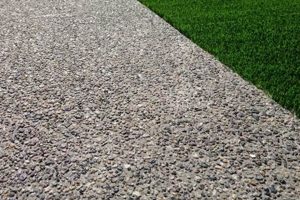
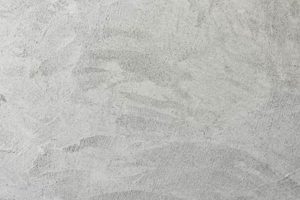
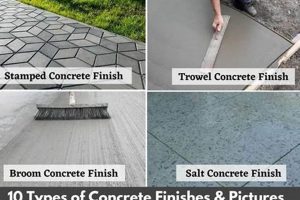
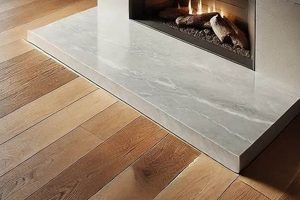
A decorative treatment for concrete, this technique involves imprinting patterns and textures onto freshly poured concrete surfaces to resemble materials such as brick, stone, slate, or wood. The process replicates the appearance of these materials at a lower cost than using the genuine article, while also offering increased durability and design flexibility.
This method offers significant aesthetic and practical advantages for various applications. The enhanced visual appeal elevates property value and creates visually appealing outdoor and indoor spaces. Furthermore, the durable nature of concrete ensures a long-lasting surface that resists wear and tear, reducing maintenance costs. Historically, this surfacing solution has provided an economical alternative to natural paving materials, allowing for widespread accessibility to decorative hardscaping.
The ensuing discussion will delve into the application process, design options, cost considerations, and maintenance requirements associated with this increasingly popular decorative concrete option.
Essential Considerations for Decorative Concrete Surfaces
Achieving optimal results requires careful planning and execution. The following guidelines address critical aspects, contributing to the longevity and aesthetic appeal of the finished product.
Tip 1: Proper Subgrade Preparation: A stable and well-compacted subgrade is crucial. Insufficient compaction can lead to cracking and settling, compromising the integrity of the surface. The subgrade should be properly graded to ensure adequate drainage.
Tip 2: Appropriate Concrete Mix Design: Select a concrete mix that is specifically designed for decorative applications. The mix should have the appropriate slump and workability for achieving the desired texture and pattern. Consider admixtures to enhance durability and resistance to environmental factors.
Tip 3: Timely Application of Release Agent: Applying a release agent is essential to prevent the stamps from sticking to the concrete surface. Ensure even coverage to avoid uneven coloration or texture transfer. Choose a release agent compatible with the chosen color hardener.
Tip 4: Precise Stamp Alignment: Maintaining consistent alignment during the imprinting process is vital for a uniform and aesthetically pleasing result. Use string lines or other guides to ensure accuracy and prevent pattern distortion.
Tip 5: Correct Curing Practices: Proper curing is essential for concrete strength and durability. Employ appropriate curing methods, such as applying a curing compound or covering the surface with plastic sheeting, to retain moisture and prevent premature drying.
Tip 6: Strategic Control Joint Placement: Implement control joints strategically to manage shrinkage and minimize the risk of random cracking. Joints should be placed at regular intervals and at points of stress concentration, such as corners or intersections.
Tip 7: Sealing for Protection and Enhancement: Applying a high-quality sealer protects the surface from staining, abrasion, and UV damage. Sealing also enhances the color and texture, providing a richer, more vibrant appearance. Reapplication may be required periodically.
By adhering to these guidelines, professionals and homeowners can ensure a successful and visually appealing installation, providing a durable and beautiful surface for years to come.
The subsequent sections will explore common problems encountered during installation and maintenance, and offer solutions for addressing these challenges.
1. Color Hardener Application

Color hardener application is a critical step in achieving desired aesthetics and durability in stamped concrete finishes. This process involves introducing a dry-shake material onto the surface of freshly placed concrete, enriching the color and enhancing the concrete’s resistance to wear.
- Timing of Application
The precise timing of color hardener application is paramount. Applying the material too early can result in the hardener sinking into the concrete without properly bonding, while applying it too late may prevent adequate absorption. The concrete surface must reach a plastic state, where it is firm enough to support the hardener but still porous enough to allow absorption. Experience and careful observation are required to determine the optimal moment for application, impacting the uniformity and intensity of the final color.
- Application Technique
Even distribution of the color hardener is essential for a consistent finish. Typically, the material is applied in two or more passes, ensuring uniform coverage and color saturation. Broadcasting the hardener by hand or using a mechanical spreader are common methods. Each pass should be worked into the concrete surface using a float or trowel, allowing the hardener to integrate with the concrete matrix. Inconsistent application can lead to mottled or uneven coloration, detracting from the overall aesthetic.
- Material Composition and Properties
Color hardeners are typically composed of cement, pigments, aggregates, and other additives. The choice of pigments significantly impacts the final color and UV resistance of the surface. Aggregates contribute to the hardness and abrasion resistance of the hardened concrete. Additives may include water repellents or plasticizers to improve workability and durability. Selecting a high-quality color hardener with appropriate properties for the intended environment is crucial for long-term performance.
- Impact on Durability
Beyond aesthetics, color hardeners significantly enhance the durability of stamped concrete finishes. The addition of hard aggregates and cementitious materials increases the concrete’s resistance to abrasion, impact, and freeze-thaw cycles. This enhanced durability extends the lifespan of the surface and reduces maintenance requirements. Properly applied color hardeners create a dense, wear-resistant surface that can withstand heavy foot traffic and exposure to harsh environmental conditions.
In summary, the successful integration of color hardener application is fundamental to both the appearance and longevity of stamped concrete finishes. Mastering the timing, technique, and material selection ensures a visually appealing and durable surface that meets both aesthetic and functional requirements.
2. Pattern Stamp Selection

The selection of pattern stamps directly dictates the aesthetic outcome and perceived value of stamped concrete finishes. It constitutes a critical decision point influencing both the visual impact and the perceived authenticity of the simulated material. Meticulous consideration of available options and their compatibility with the project’s overall design is paramount.
- Material Replication Accuracy
The fidelity with which a stamp replicates the texture and detail of natural materials significantly affects the realism of the finish. High-quality stamps exhibit intricate patterns that convincingly mimic stone, brick, or wood. In contrast, poorly designed stamps may produce repetitive or unnatural-looking impressions, diminishing the overall aesthetic appeal and undermining the perceived value of the installation. Precise replication is thus vital.
- Pattern Complexity and Repeat Frequency
The complexity of the chosen pattern, along with the frequency of its repetition, determines the visual interest and perceived randomness of the surface. Patterns with minimal variation or overly frequent repeats can appear artificial and monotonous. More intricate and less repetitive patterns create a more organic and visually engaging appearance. Balancing complexity and repetition is crucial for achieving a natural and appealing result. The size of the pattern relative to the area being stamped is also important. A very small pattern on a large area can look too busy, while a very large pattern on a small area may not be fully appreciated.
- Stamp Material and Durability
The material composition and durability of the stamps directly impact the quality and consistency of the impressions. Stamps constructed from durable materials, such as polyurethane, are capable of withstanding repeated use without significant wear or distortion. This ensures consistent pattern transfer and minimizes the risk of imperfections. Inferior stamps, made from less durable materials, may exhibit premature wear, resulting in blurred or inconsistent impressions. Careful selection of stamps made from robust materials is therefore essential for long-term performance and aesthetic quality.
- Texture Depth and Variation
The depth and variation of the stamp’s texture influence the perceived three-dimensionality and realism of the finished surface. Stamps with varying texture depths create a more dynamic and visually engaging appearance, simulating the natural irregularities found in materials like stone or slate. Flat or uniformly textured stamps, conversely, can result in a less convincing and visually flat surface. The texture of the stamp also affects the slip resistance of the final surface. A more textured surface will provide better traction, which is especially important for outdoor applications.
Therefore, the proper selection of pattern stamps should be based on the project’s intended design style, budget, and the desired level of realism. Thorough evaluation of available patterns, material quality, and texture characteristics is essential for achieving a visually compelling and long-lasting stamped concrete finish. The impact of the selected pattern extends beyond mere aesthetics, influencing the perceived value, durability, and overall satisfaction with the installed surface.
3. Sealer Type
The selection of an appropriate sealer is paramount to the longevity and aesthetic preservation of stamped concrete finishes. Sealers serve as a protective barrier against environmental factors, abrasion, and staining, directly influencing the durability and visual appeal of the finished surface.
- Acrylic Sealers: Enhancing Aesthetics, Balancing Protection
Acrylic sealers, commonly employed in stamped concrete applications, enhance the color and sheen of the surface while providing a moderate level of protection against water penetration and UV exposure. Their ease of application and relatively low cost make them a popular choice for residential projects. However, acrylic sealers offer limited resistance to abrasion and chemical spills compared to other options, necessitating periodic reapplication to maintain their protective qualities. An example would be using an acrylic sealer on a residential patio to enhance the color of the stamped pattern and protect it from light foot traffic and occasional spills.
- Polyurethane Sealers: Superior Durability for High-Traffic Areas
Polyurethane sealers offer superior abrasion resistance and chemical resistance compared to acrylics, making them suitable for high-traffic areas such as driveways and commercial spaces. These sealers form a durable film that protects the concrete from wear, staining, and the damaging effects of de-icing salts. Polyurethane sealers may impart a glossy finish, altering the original aesthetic of the stamped surface. Their higher cost and more complex application process are factors to consider. A commercial driveway using stamped concrete for decorative purposes would benefit from polyurethane’s resilience.
- Epoxy Sealers: Industrial-Grade Protection, Specialized Applications
Epoxy sealers provide exceptional chemical resistance and durability, making them appropriate for industrial settings or environments exposed to harsh chemicals. While offering superior protection, epoxy sealers can be less flexible than other options and may be susceptible to scratching or yellowing over time when exposed to UV radiation. Their specialized application requirements and potential for altering the surface appearance necessitate careful consideration. An example might be a stamped concrete floor in a manufacturing facility that needs protection from chemical spills.
- Penetrating Sealers: Invisible Protection, Preserving Natural Appearance
Penetrating sealers, such as silanes and siloxanes, work by penetrating the concrete surface and reacting chemically to create a water-repellent barrier. These sealers do not alter the appearance of the concrete, preserving its natural texture and color. Penetrating sealers offer limited protection against abrasion and staining but can significantly reduce water absorption, minimizing the risk of freeze-thaw damage. They are often used as a base coat prior to the application of a topical sealer for enhanced protection. A stamped concrete walkway, where a natural look is desired, can use a penetrating sealer for water resistance without changing its appearance.
The selection of the appropriate sealer type requires careful assessment of the intended use, environmental conditions, and desired aesthetic outcome of the stamped concrete finish. Understanding the properties and limitations of each sealer type is crucial for ensuring long-term performance and preserving the visual integrity of the decorative surface.
4. Subgrade Preparation

Proper subgrade preparation is foundational to the structural integrity and long-term performance of stamped concrete finishes. It provides a stable base, mitigating the risk of settling, cracking, and other forms of distress that compromise the aesthetic appeal and functionality of the finished surface.
- Compaction and Stability
The subgrade must be thoroughly compacted to achieve a uniform density. Inadequate compaction can lead to differential settling, resulting in cracks and uneven surfaces within the stamped concrete. For instance, a driveway subgrade that is not properly compacted may exhibit cracking patterns after several freeze-thaw cycles, particularly if heavy vehicles are regularly used. The stability of the subgrade directly influences the load-bearing capacity and overall durability of the decorative concrete layer.
- Drainage and Moisture Control
Effective drainage is essential for preventing water accumulation beneath the concrete slab. Excess moisture can saturate the subgrade, weakening its load-bearing capacity and contributing to heaving during freezing temperatures. Proper grading and the installation of drainage systems, such as French drains, can divert water away from the subgrade. Consider a patio installation where poor drainage leads to water pooling beneath the concrete, eventually causing the surface to lift and crack. The ability of the subgrade to manage moisture significantly affects the long-term stability of the concrete.
- Material Composition and Bearing Capacity
The type of material used for the subgrade influences its bearing capacity and drainage characteristics. Granular materials, such as gravel or crushed stone, provide excellent drainage and compaction properties. Conversely, clay-rich soils tend to retain moisture and are more susceptible to frost heave. Selecting appropriate subgrade materials and ensuring adequate bearing capacity are crucial for supporting the weight of the concrete and anticipated traffic loads. For example, replacing a clay-based subgrade with a gravel base can significantly improve the performance of a stamped concrete driveway in regions with heavy rainfall.
- Grading and Leveling
Achieving a level and properly graded subgrade is critical for ensuring a uniform concrete thickness and preventing water ponding on the finished surface. Precise grading allows for consistent pattern depth during the stamping process and contributes to the overall aesthetic appeal of the installation. Inaccurate grading can result in uneven surfaces and drainage issues, detracting from the visual impact of the stamped concrete. Proper leveling with equipment such as laser levels ensures the finished product meets the desired specifications.
The foregoing facets underscore the critical role of subgrade preparation in stamped concrete applications. Neglecting this aspect can lead to premature failure, increased maintenance costs, and diminished aesthetic appeal. A well-prepared subgrade provides a solid foundation, ensuring the longevity and performance of the decorative concrete surface.
5. Control Joint Placement

Strategic placement of control joints is essential for mitigating the inherent risk of cracking in stamped concrete finishes. These joints are intentionally created planes of weakness, designed to accommodate the stresses induced by concrete shrinkage and thermal expansion, thereby directing cracking along predetermined lines and preserving the aesthetic integrity of the decorative surface.
- Minimizing Random Cracking
The primary function of control joints is to manage tensile stresses within the concrete. By creating weakened planes, these joints encourage cracking to occur predictably along the joint lines, rather than randomly across the surface. Random cracking detracts from the visual appeal of stamped concrete and can compromise its structural integrity. For example, a large patio without properly spaced control joints is highly susceptible to unsightly, irregular cracks that disrupt the intended pattern and reduce the surface’s longevity. Judicious placement of these joints effectively channels the energy of cracking, preserving the overall appearance.
- Joint Spacing and Panel Dimensions
The appropriate spacing of control joints is governed by the concrete thickness, aggregate size, and environmental conditions. Generally, joint spacing should not exceed 24 to 36 times the slab thickness (in inches), and panel dimensions should approximate a square shape. Elongated panels are more prone to cracking, necessitating closer joint spacing. Consider a stamped concrete driveway with panels exceeding a 1.5:1 length-to-width ratio; such a design would significantly increase the likelihood of uncontrolled cracking due to restrained shrinkage. Adherence to recommended spacing guidelines ensures effective stress relief.
- Alignment with Stamped Patterns
Thoughtful alignment of control joints with the chosen stamped pattern can minimize their visual impact. Integrating the joints into grout lines or natural divisions within the pattern can effectively camouflage their presence. For example, when replicating a flagstone pattern, control joints can be strategically positioned to coincide with the mortar joints between the stones, rendering them virtually invisible. This careful integration preserves the aesthetic continuity of the stamped surface, ensuring that the joints do not detract from the overall visual effect. This requires detailed planning during the design phase.
- Joint Depth and Construction Methods
Control joints should be cut or formed to a depth of at least one-quarter of the slab thickness. Early-entry dry-cut sawing is a common method for creating control joints in fresh concrete. This technique minimizes the risk of raveling and produces clean, precise joints. Alternatively, tooled joints can be formed during the finishing process. Regardless of the method employed, proper joint depth is essential for ensuring that cracking occurs preferentially along the intended lines. Shallow joints may be ineffective in relieving stress, leading to cracking elsewhere on the surface.
In conclusion, careful planning and execution of control joint placement are indispensable for achieving durable and aesthetically pleasing stamped concrete finishes. By understanding the principles of stress management and integrating the joints seamlessly into the stamped pattern, practitioners can effectively minimize the risk of uncontrolled cracking and ensure the long-term performance of these decorative surfaces. Strategic joint placement becomes an integral part of the overall design, rather than an afterthought, maximizing both structural integrity and visual appeal.
6. Curing Process

The curing process is a critical phase immediately following the stamping of concrete, significantly influencing the ultimate strength, durability, and aesthetic quality of decorative concrete surfaces. Optimal hydration of the cementitious materials is essential for achieving the desired performance characteristics in stamped concrete finishes.
- Hydration Rate and Strength Development
The rate at which concrete hydrates directly affects the development of its compressive and flexural strength. Proper curing maintains adequate moisture levels, allowing cement particles to fully hydrate and form strong bonds. Inadequate curing leads to premature drying, halting hydration and resulting in weaker, more porous concrete. For example, a stamped concrete patio cured improperly during hot weather will exhibit lower compressive strength and increased susceptibility to cracking compared to a properly cured counterpart. The hydration rate is therefore intrinsically linked to the structural integrity of the finished product.
- Minimizing Plastic Shrinkage Cracking
Plastic shrinkage cracking occurs when the surface of freshly placed concrete dries too rapidly, causing it to shrink before it has gained sufficient strength. Effective curing methods, such as applying a curing compound or covering the surface with plastic sheeting, reduce the rate of evaporation and minimize the risk of these cracks. A stamped concrete driveway left uncured on a windy day is highly vulnerable to plastic shrinkage cracking, which can detract from its aesthetic appeal and compromise its long-term durability. Controlling the evaporation rate is therefore a primary objective of proper curing practices.
- Influencing Color Uniformity and Hardener Integration
The curing process can influence the uniformity of color and the integration of color hardeners in stamped concrete finishes. Maintaining consistent moisture levels during curing promotes even hydration of the cement and pigments, resulting in a more uniform and vibrant color. Rapid drying can lead to uneven color distribution and efflorescence. Consider a stamped concrete walkway where inconsistent curing results in mottled coloration and reduced color intensity, undermining the intended aesthetic. Controlled curing enhances the visual appeal by promoting uniform pigment distribution.
- Impact on Abrasion Resistance and Surface Durability
Proper curing significantly enhances the abrasion resistance and overall surface durability of stamped concrete. Well-hydrated concrete exhibits a denser, more tightly bound surface matrix, making it more resistant to wear and tear. Inadequate curing results in a weaker surface layer that is more prone to abrasion and scaling. A stamped concrete floor in a high-traffic area that has been improperly cured will exhibit premature wear and tear compared to a properly cured surface. The curing process therefore plays a critical role in maximizing the lifespan and performance of stamped concrete finishes.
These elements illustrate the interconnectedness of the curing process and the overall success of stamped concrete finishes. Effective curing practices contribute to enhanced strength, reduced cracking, improved color uniformity, and increased durability, ultimately ensuring a long-lasting and aesthetically pleasing decorative surface.
Frequently Asked Questions About Stamped Concrete Finishes
The following addresses prevalent inquiries regarding stamped concrete finishes, providing insights into their properties, application, and maintenance.
Question 1: What is the typical lifespan of a stamped concrete surface?
The lifespan of a stamped concrete surface is influenced by several factors, including the quality of the installation, the prevailing environmental conditions, and the level of maintenance it receives. Properly installed and maintained stamped concrete can last for 25 years or more. However, exposure to harsh chemicals, heavy traffic, and freeze-thaw cycles can reduce its lifespan.
Question 2: Is stamped concrete more slippery than regular concrete?
Stamped concrete can be more slippery than regular concrete, particularly when wet. The application of a sealer, while enhancing its appearance and durability, can further reduce its slip resistance. To mitigate this risk, consider incorporating a non-slip additive into the sealer or opting for a textured stamp pattern that provides better traction.
Question 3: Can stamped concrete be installed over existing concrete?
While it is possible to install a thin overlay of stamped concrete over existing concrete, the success of this application depends on the condition of the underlying slab. The existing concrete must be structurally sound, free of significant cracks, and properly prepared to ensure adequate bonding. If the existing concrete is severely damaged, a complete replacement is generally recommended.
Question 4: How does the cost of stamped concrete compare to other paving options?
The cost of stamped concrete typically falls between that of traditional concrete and more expensive paving materials, such as natural stone. While the initial investment may be higher than regular concrete, the added aesthetic value and design flexibility can make it a cost-effective option in the long run. The overall cost is influenced by factors such as the complexity of the pattern, the size of the project, and the labor costs in the region.
Question 5: What maintenance is required for stamped concrete finishes?
Stamped concrete requires regular cleaning and periodic resealing to maintain its appearance and durability. Regular sweeping and washing with a mild detergent can remove dirt and debris. Resealing every two to three years is recommended to protect the surface from staining, abrasion, and UV damage. Avoid using de-icing salts, as they can damage the concrete surface.
Question 6: Are there limitations to the patterns and colors available for stamped concrete?
Stamped concrete offers a wide range of patterns and colors, allowing for extensive design flexibility. Patterns can replicate various materials, including brick, stone, slate, and wood. Colors can be customized to match existing landscaping or architectural elements. However, some intricate patterns or custom colors may incur additional costs or require specialized expertise.
These answers offer guidance on key aspects. Diligent planning and execution will result in a beautiful and enduring surface.
The following section will explore best practices for selecting a qualified contractor experienced in decorative concrete applications.
Stamped Concrete Finishes
This exploration of stamped concrete finishes has illuminated critical aspects, encompassing application techniques, design considerations, and maintenance protocols. The durability, aesthetic versatility, and cost-effectiveness relative to natural materials are primary drivers of its popularity. Careful attention to subgrade preparation, precise color hardener application, strategic control joint placement, appropriate sealer selection, and diligent curing practices are paramount for achieving optimal long-term performance.
The successful implementation of stamped concrete finishes requires a comprehensive understanding of material properties and installation best practices. Professionals and property owners should prioritize informed decision-making, ensuring that design choices and construction methods align with the intended use and environmental conditions. By adhering to rigorous standards, the full potential of stamped concrete as a durable and visually appealing surfacing solution can be realized.