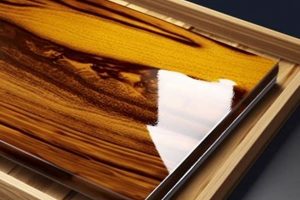
A dark, rich tone applied to wood surfaces to mimic the appearance of walnut. This application can be achieved through stains, paints, or veneers, imparting a sophisticated aesthetic to furniture, cabinetry, and architectural elements. An example would be a desk constructed of maple, stained to resemble the color and grain patterns of this prized hardwood.
The coloration offers warmth and elegance, often associated with high-quality craftsmanship. Its versatility allows it to complement a wide range of design styles, from traditional to contemporary. Historically, the demand for genuine articles influenced the development of techniques to reproduce its attractive features on less expensive or more readily available materials. This replication made a desirable look accessible to a broader audience.
The following sections will delve into the specific methods used to achieve a dark tone on wood, explore the various applications where this aesthetic is prevalent, and examine the care and maintenance required to preserve the integrity of the surface treatment. Furthermore, this article will discuss the value and demand in contemporary design, as well as sustainable alternatives to achieve similar results.
Tips for Maintaining a Dark Tone on Wood
Proper care ensures the longevity and beauty of the dark colored surface. These recommendations offer insights into preserving the integrity of both the coloration and the underlying wood.
Tip 1: Minimize Direct Sunlight Exposure: Prolonged exposure to ultraviolet (UV) radiation can cause fading and discoloration. Utilize window treatments or strategically position furniture to reduce direct sunlight.
Tip 2: Use Appropriate Cleaning Solutions: Avoid harsh chemicals or abrasive cleaners. Opt for mild, pH-neutral soap diluted in water, applied with a soft cloth.
Tip 3: Regularly Dust Surfaces: Dust particles can accumulate and scratch the surface over time. Use a microfiber cloth or a duster to remove dust gently.
Tip 4: Apply a Protective Wax or Polish: Periodic application of a high-quality wax or polish can create a barrier against moisture and scratches, enhancing the depth of the tone.
Tip 5: Address Scratches Promptly: Minor scratches can be concealed with touch-up markers or repair kits specifically designed for wood finishes. Deeper scratches may require professional refinishing.
Tip 6: Control Humidity Levels: Extreme fluctuations in humidity can cause wood to expand or contract, potentially damaging the finish. Maintain consistent humidity levels within the environment.
Tip 7: Avoid Placing Hot or Wet Items Directly on the Surface: Use coasters or placemats to protect the wood from heat and moisture, preventing water rings and potential damage.
Consistent application of these techniques will contribute significantly to the preservation of both the aesthetic appeal and structural integrity of the treated wood.
The subsequent section will explore common issues associated with maintaining wood, and address frequently asked questions about upkeep.
1. Color Depth

Color depth, within the context of achieving the appearance, relates directly to the perceived richness and saturation of the applied hue. This characteristic is instrumental in replicating the visual impact of genuine walnut, a wood known for its complex, dark, and often chocolatey tones. The depth of color influences the perception of quality; a shallow, washed-out tone fails to capture the inherent elegance, while a deep, saturated tone more effectively mimics the visual characteristics of solid material. For example, a light maple wood inadequately stained may lack sufficient color depth, appearing artificial and unconvincing.
The method of application and the number of coats significantly affect the depth of the color. Multiple coats of stain, properly applied, allow the pigment to build incrementally, increasing the saturation and depth of the resulting tone. Conversely, a single, thin application may result in an insufficient depth, failing to achieve the desired resemblance. The selection of the correct stain formula, with appropriate pigment concentration, is therefore critical. Using a wiping stain, for instance, allows for better control over the intensity, as excess stain can be removed to achieve the ideal depth.
In summary, understanding and controlling color depth are essential to faithfully replicate the appearance of walnut on other wood types. This control, achieved through careful stain selection, application technique, and surface preparation, directly affects the overall success of the imitation. Achieving a color too light or too dark diminishes the authenticity, highlighting the importance of precise and measured steps throughout the finishing process.
2. Grain pattern

The grain pattern is an indispensable component of a wood finish that mimics walnut. The distinctive appearance of true walnut wood is defined, in large part, by its grain. Therefore, replicating this grain pattern accurately is crucial to achieving a convincing imitation. A failure to properly represent the grain diminishes the illusion, regardless of the accuracy of the color. The cause and effect are clear: a well-executed grain pattern results in a realistic appearance, while a poorly executed one detracts from it. Real-life examples abound, such as less expensive furniture using printed overlays intended to simulate walnut grain, often appearing flat and unconvincing due to the lack of depth and variation inherent in natural wood grain.
Various techniques are employed to replicate the grain effectively. Staining techniques, for example, can accentuate the natural grain of the underlying wood. For woods with a less pronounced grain, techniques like faux graining or using graining tools are utilized. The practical significance of understanding this is substantial: furniture makers can use less expensive woods while still achieving a high-end aesthetic. Architects and designers can incorporate the warmth and richness of walnut into projects with tighter budgetary constraints. Further, careful alignment of veneer or printed grain patterns is essential for achieving a seamless and convincing imitation, especially in large surfaces like tabletops or cabinet doors.
In conclusion, the grain pattern forms a vital element in simulating the look of walnut. Successful replication demands careful attention to detail, utilizing appropriate techniques to either enhance existing grain or create an artificial one. While challenges exist in perfectly mirroring the complexities of natural grain, understanding its importance is paramount for manufacturers, designers, and consumers seeking an affordable alternative to solid walnut.
3. Application method

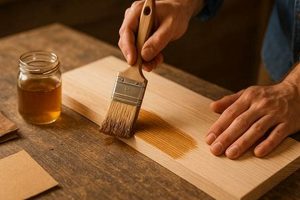
The application method is intrinsically linked to the success of simulating a finish. This process dictates the appearance and longevity of the simulated grain. Improper application will invariably yield unsatisfactory results. The cause and effect relationship is direct: a skilled application yields a convincing aesthetic, while a flawed one results in an unconvincing imitation. For instance, applying a stain unevenly will produce a blotchy, inconsistent color that detracts from the desired richness. Applying a veneer without proper adhesion can lead to bubbling and peeling, undermining the overall appearance. In a furniture production setting, prioritizing speed over precision in applying the coloration often results in a substandard product.
The choice of application technique is varied, each with its advantages and disadvantages. Staining is commonly employed, relying on the woods natural grain to contribute to the overall effect. This method is cost-effective and relatively straightforward but requires careful preparation and even application to avoid uneven absorption. Veneering involves adhering a thin slice of real or faux onto a substrate, offering a more consistent appearance but demanding precise cutting and gluing. Printing techniques, wherein the simulated pattern is printed directly onto the surface, provide the most uniform result, but can lack the depth and texture of other methods. A practical application of this understanding involves carefully selecting the application technique that matches the specific properties of the underlying wood. For instance, using a gel stain on woods with tight grains and pores, such as maple, provides more even coloration, mitigating the blotching.
In summary, the application method represents a critical determinant in achieving a finish on wood. Selection of the appropriate method depends on factors such as the desired aesthetic, budget constraints, and the characteristics of the underlying wood. The challenge lies in mastering the nuances of each technique to ensure a consistent, high-quality result that convincingly emulates the beauty and depth of genuine material. Ultimately, a deep understanding of application methodologies is paramount for producing convincing and durable surfaces.
4. Protective coating

A protective coating represents a crucial element in preserving the aesthetic and structural integrity of wood treated to resemble walnut. The effect of this coating is directly proportional to its quality and application: a well-chosen and properly applied coating significantly extends the life and enhances the appearance, while a substandard or poorly applied one compromises both. For example, a polyurethane coating provides a durable, moisture-resistant barrier, safeguarding against scratches, spills, and fading, common threats to wood surfaces. Without such protection, surfaces are susceptible to damage, diminishing their visual appeal and potentially requiring costly repairs or refinishing. The practical significance lies in the prevention of premature wear, maintaining the desired aesthetic over time.
The selection of the appropriate protective coating depends on several factors, including the intended use of the item and the type of finish applied. For high-traffic surfaces such as tabletops or floors, a more robust coating like polyurethane or a catalyzed varnish is essential to withstand daily wear. For decorative items or furniture subjected to less frequent use, a wax or oil finish may suffice, offering a softer sheen and easier repairability. A common challenge involves selecting a coating that provides adequate protection without altering the color or sheen of the stain. Some coatings can impart a yellowish tint or an overly glossy finish, detracting from the desired walnut aesthetic. Careful consideration of these factors is crucial for achieving the optimal balance between protection and visual appeal.
In conclusion, a protective coating is not merely an optional addition but a vital component in maintaining the beauty and durability of surfaces. Its proper selection and application are paramount for preventing damage, preserving the finish’s color and sheen, and extending the lifespan of the treated wood. The challenge lies in understanding the various types of protective coatings and their suitability for different applications, ensuring long-term enjoyment and value. Neglecting this step undermines the investment in the finishing process.
5. Material selection

The choice of underlying wood species exerts a significant influence on the final appearance and long-term performance when a walnut-like coloration is desired. The inherent properties of the wood, including its grain pattern, density, and color, interact with the applied finish, dictating the depth of tone, texture, and overall aesthetic. Careful material selection is therefore paramount to achieving a convincing and durable imitation.
- Grain Compatibility
The grain pattern of the substrate should ideally complement the characteristic grain of real material. Close-grained woods, such as maple or birch, require specific techniques to mimic the open-pore appearance often found in genuine pieces. If woods are not compatable, open-pore woods, such as oak or ash, can exhibit a grain pattern that competes with the finish, requiring grain-filling or other treatments to achieve a smooth, uniform surface. The selection therefore must balance the desired aesthetics with the ease and cost of the finishing process.
- Color Undertones
The natural color undertones of the wood impact the final color. Woods with yellow or red undertones, such as pine or cherry, may require more coats of stain or tinted sealers to neutralize these undertones and achieve the desired dark, neutral hue. Conversely, lighter-colored woods like poplar may require fewer coats. A poor choice of wood can result in the color failing to fully represent the material, regardless of applied stain. Achieving a convincing outcome necessitates attention to the base color, requiring adjustments in the staining process.
- Porosity and Absorption
The wood species’ porosity dictates how readily it absorbs the stain or finish. Woods like pine, which are highly porous, tend to absorb stain unevenly, resulting in a blotchy appearance. This uneven absorption can be mitigated through the use of pre-stain conditioners, which seal the wood surface and promote more uniform stain absorption. However, pre-stain treatments can affect the final darkness of the tone, altering its characteristics. In contrast, denser woods like maple may require longer staining times or multiple coats to achieve the desired depth of color.
- Dimensional Stability
The wood’s dimensional stability influences the longevity of the finish. Woods prone to significant expansion and contraction with changes in humidity can cause the finish to crack or peel. Choosing a stable wood species, or employing construction techniques that accommodate movement, minimizes the risk of damage. Example: Using engineered wood products, such as plywood or MDF, as a substrate offers increased dimensional stability compared to solid wood, reducing the likelihood of finish failure. Ultimately, selecting stable material will guarantee the surface look good over time.
These considerations collectively illustrate the interconnectedness of material selection and the overall success of achieving a walnut-like tone. Selecting a wood with appropriate grain characteristics, undertones, porosity, and stability significantly simplifies the finishing process and enhances the final result. Conversely, disregarding these factors can lead to a finish that is both aesthetically unconvincing and prone to premature failure. It is also a main factor of whether the walnut finished last long.
6. Surface preparation
Proper surface preparation is a prerequisite for achieving a durable and aesthetically pleasing finish on wood surfaces. The degree to which the surface is properly prepared dictates the ultimate success of any subsequent finishing steps, including the application of a walnut-tone treatment. Inadequate attention to preparation will invariably result in a compromised result, regardless of the quality of the finish product itself.
- Sanding and Smoothing
Sanding removes imperfections, such as scratches, dents, and mill marks, creating a smooth, uniform surface that allows for even stain absorption. Varying grit levels are employed, starting with coarser grits to remove significant defects and progressing to finer grits to refine the surface. Insufficient sanding results in an uneven color. For example, leaving swirl marks from coarse sandpaper visible on the final surface. Effective sanding is non-negotiable for a professional application.
- Cleaning and Dust Removal
Contaminants such as dust, dirt, grease, and waxes inhibit the adhesion of the finish, leading to peeling, chipping, or an uneven appearance. Thorough cleaning with appropriate solvents or cleaners is essential to remove these contaminants. Compressed air, tack cloths, and vacuuming are commonly employed to remove dust particles from the surface and crevices. If the finish is applied over a contaminated surface, peeling will be obvious in real life.
- Repairing Imperfections
Surface imperfections, such as cracks, gouges, and knot holes, must be addressed prior to finishing to ensure a smooth, uniform appearance. Wood fillers or epoxy resins are used to fill these imperfections, providing a level surface for stain or finish application. Improperly filled imperfections result in noticeable defects beneath the finish, detracting from the overall aesthetic. Properly repair them will deliver professional application.
- Pre-Stain Conditioning
Some wood species, particularly softwoods and woods with uneven density, are prone to blotchy stain absorption. Pre-stain conditioners seal the wood surface, reducing the amount of stain absorbed and promoting more uniform coloration. The selection of an appropriate pre-stain conditioner is crucial to prevent over-sealing, which can inhibit stain penetration and result in a pale or washed-out appearance. Without proper conditioning, blotchiness becomes more obvious.
These steps collectively contribute to creating an optimal surface for the application of a finish. By addressing imperfections, removing contaminants, and ensuring uniform stain absorption, the substrate is prepared to receive the finish in a manner that maximizes its aesthetic appeal and durability. Neglecting these essential preparatory steps invariably results in a compromised final outcome, regardless of the quality of the topcoat or staining material used.
Frequently Asked Questions
The following addresses common inquiries and clarifies potential misconceptions associated with wood coloration.
Question 1: How does wood finish compare to solid wood in terms of durability?
Solid wood, by its nature, may possess greater structural integrity and longevity. However, a properly applied and maintained finish can significantly enhance the durability of other wood types, providing resistance to scratches, moisture, and UV damage. The durability is dependent on the quality of the materials and application techniques.
Question 2: Can a applied stain be made to look exactly like solid walnut?
While modern finishing techniques can closely approximate the appearance of solid material, subtle differences in grain pattern, texture, and color depth may remain. The degree of similarity depends on the skill of the finisher and the quality of the materials used. Absolute replication is difficult to achieve.
Question 3: What is the best way to clean surfaces without damaging the finish?
Gentle cleaning with a soft cloth and a mild, pH-neutral soap solution is recommended. Harsh chemicals, abrasive cleaners, and excessive moisture should be avoided. Regular dusting prevents the buildup of particles that can scratch the surface.
Question 4: Does exposure to sunlight affect surfaces over time?
Yes. Prolonged exposure to ultraviolet (UV) radiation can cause fading, discoloration, and degradation of the finish. Window treatments, UV-resistant coatings, and strategic furniture placement can mitigate these effects.
Question 5: Are there environmentally friendly alternatives to traditional stains and finishes?
Yes. Water-based stains, natural oil finishes, and low-VOC (volatile organic compound) coatings offer more sustainable alternatives. These options reduce environmental impact and improve indoor air quality.
Question 6: How can scratches and minor damage be repaired?
Minor scratches can often be concealed with touch-up markers or wax sticks specifically designed for wood finishes. Deeper scratches may require professional refinishing. Prompt attention to damage prevents further deterioration.
In summary, understanding the properties, care requirements, and potential limitations of wood finishing is essential for informed decision-making and long-term satisfaction.
The subsequent section will explore sustainable options for achieving a dark finish on wood.
Walnut Finish Wood
This exploration of walnut finish wood has illuminated its multifaceted nature, encompassing aesthetic replication, durability considerations, and maintenance protocols. The analyses of color depth, grain pattern, application methods, protective coatings, material selection, and surface preparation underscore the complexities involved in achieving a convincing and lasting effect. Furthermore, the discussion of potential pitfalls and frequently asked questions provides essential insights for informed decision-making regarding its implementation and care.
The information presented serves as a framework for understanding the nuances and challenges associated with replicating the appearance of material on other surfaces. As design trends evolve and sustainability concerns gain prominence, a thorough comprehension of these factors becomes increasingly crucial for both consumers and professionals alike. Continued vigilance regarding responsible sourcing, proper application techniques, and conscientious maintenance will ensure the enduring beauty and value of these treatments for years to come.
![Buy Premium Walnut Finished Wood [Deals Inside] | Best Final Touch: Elevate Your Projects with Professional Finishing](https://bestfinaltouch.com/wp-content/uploads/2026/05/th-405-300x200.jpg "Buy Premium Walnut Finished Wood [Deals Inside] Best Final Touch: Elevate Your Projects with Professional Finishing")