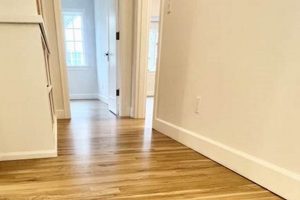
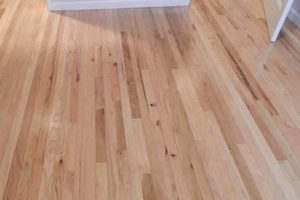
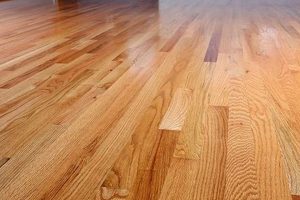
Wood flooring that undergoes its staining and protective coating application at the factory, rather than the installation site, presents a distinct alternative in building materials. This manufactured product offers a consistent finish, controlled environment application, and typically shorter installation times when compared to unfinished material. For example, a homeowner selecting this option can often walk on their new floor immediately after installation, avoiding the downtime associated with on-site finishing.
The utilization of this product offers numerous advantages, primarily related to time and environmental control. Factory finishing ensures consistent color and sheen, minimizing variations that can occur during on-site application. Furthermore, the absence of volatile organic compounds (VOCs) emitted during the finishing process significantly improves indoor air quality during installation. Historically, the development of these options was driven by the desire to reduce installation time and improve the overall consistency and quality of the final product.
The subsequent sections will delve into the various types of this floor covering available, their installation processes, maintenance considerations, and a comparison with other flooring options. This will provide a complete understanding of its characteristics and how it aligns with diverse project needs.
Tips for Selecting and Maintaining Pre-Finished Hardwood Flooring
This section offers guidance on choosing and caring for factory-finished hardwood, ensuring longevity and aesthetic appeal. Careful consideration during selection and proactive maintenance are crucial for maximizing its value.
Tip 1: Assess Subfloor Condition: Before installation, ensure the subfloor is level, dry, and structurally sound. Imperfections can telegraph through the flooring, compromising its appearance and potentially leading to premature wear. Use a self-leveling compound to correct minor irregularities.
Tip 2: Consider Plank Width and Length: Wider planks can enhance the visual impact of larger rooms, while longer lengths minimize the appearance of seams. Evaluate the room’s dimensions to determine the most aesthetically pleasing and structurally stable option.
Tip 3: Evaluate Finish Durability: Factory-applied finishes vary in durability. Investigate the finish type (e.g., aluminum oxide, urethane) and its scratch resistance. Higher-traffic areas necessitate more durable finishes.
Tip 4: Understand Installation Methods: Factory-finished hardwood can be installed using various methods, including nail-down, glue-down, and floating. The appropriate method depends on the subfloor type and the flooring product specifications. Adhere strictly to the manufacturer’s instructions.
Tip 5: Implement Regular Cleaning Practices: Sweep or vacuum regularly to remove dirt and debris. Use a manufacturer-recommended hardwood floor cleaner, avoiding excessive moisture. Never use abrasive cleaners or scouring pads.
Tip 6: Control Humidity Levels: Hardwood is susceptible to expansion and contraction with fluctuations in humidity. Maintain consistent humidity levels within the recommended range (typically 35-55%) to prevent warping or gapping.
Tip 7: Protect Against Direct Sunlight: Prolonged exposure to direct sunlight can fade the finish and alter the wood’s color. Utilize curtains, blinds, or UV-resistant window film to mitigate sunlight exposure.
Selecting the appropriate product and implementing proper maintenance practices will yield a durable and aesthetically pleasing floor covering. Understanding these considerations ensures long-term satisfaction.
The subsequent sections will explore the advantages and disadvantages of this flooring type relative to other materials, guiding informed decision-making during the selection process.
1. Factory-applied finish durability

The durability of the factory-applied finish is a critical determinant of the overall performance and longevity of pre-finished hardwood floors. This finish, typically composed of multiple layers of protective coatings, directly impacts the floor’s resistance to scratches, abrasion, staining, and the effects of ultraviolet light. A robust finish prolongs the floor’s lifespan and maintains its aesthetic appeal, reducing the need for frequent refinishing or replacement. For instance, floors with an aluminum oxide-enhanced finish exhibit superior scratch resistance compared to those with standard polyurethane coatings. This difference is readily apparent in high-traffic residential areas or commercial settings, where the latter may show signs of wear more quickly.
The selection of a pre-finished hardwood floor necessitates a thorough evaluation of the finish’s composition and its performance characteristics. Factors such as the number of finish coats, the type of curing process used (e.g., ultraviolet curing), and the presence of additives designed to enhance durability or UV resistance should be considered. Specifying a floor with a high-quality, durable finish can significantly reduce long-term maintenance costs. A practical example involves comparing two floors, one with a standard polyurethane finish and another with an acrylic-impregnated finish. The latter, while potentially more expensive initially, will likely require less frequent refinishing due to its enhanced resistance to indentation and wear.
In conclusion, the factory-applied finish is an indispensable component of pre-finished hardwood floors, directly impacting their resilience and aesthetic longevity. Understanding the characteristics and performance attributes of different finish types is crucial for selecting a product that meets specific needs and withstands anticipated levels of wear and tear. The long-term value and performance of pre-finished hardwood are inextricably linked to the quality and durability of the finish, making this a paramount consideration during the selection process.
2. Installation cost-effectiveness

Installation cost-effectiveness is a significant advantage often associated with pre-finished hardwood floors. This cost-effectiveness stems primarily from the reduced labor and time required for installation compared to unfinished hardwood. Because pre-finished flooring arrives with the stain and protective coating already applied, the time-consuming and skilled process of sanding, staining, and sealing is eliminated from the installation site. This translates to fewer days of labor, potentially lower labor costs, and reduced disruption to the homeowner or business. An example is the installation of flooring in a retail space. Choosing pre-finished hardwood allows the business to resume operations more quickly, mitigating potential revenue loss due to closure during the flooring process. The importance of this lies in achieving a balance between upfront material costs and the overall project expense, factoring in labor and time savings.
The reduced on-site finishing also minimizes the need for specialized equipment and ventilation systems to manage dust and fumes associated with sanding and applying finishes. This not only contributes to cost savings but also improves the air quality within the building during and after installation. Furthermore, pre-finished hardwood often features engineered construction, which can be more dimensionally stable and easier to install than solid hardwood, particularly in environments with fluctuating humidity levels. A practical application of this understanding involves project budgeting, where the potential cost savings from reduced labor and material handling contribute to a more favorable overall project cost. Consider a large-scale residential development; the streamlined installation process with pre-finished materials results in quicker project completion and reduced overall construction expenses.
In summary, the connection between installation cost-effectiveness and pre-finished hardwood floors is primarily driven by reduced labor, time savings, and minimized on-site finishing requirements. These factors contribute to a more predictable and potentially lower overall project cost. While the initial material cost of pre-finished hardwood may be higher than unfinished, the long-term savings associated with installation and reduced disruption make it a compelling option for many projects. Challenges may include ensuring proper subfloor preparation and selecting a pre-finished product that meets the required durability and aesthetic standards; however, the potential cost benefits remain a significant consideration in flooring decisions.
3. Dimensional stability considerations

Dimensional stability is a critical factor in the selection and performance of pre-finished hardwood floors. Hardwood, being a natural material, is susceptible to expansion and contraction in response to changes in ambient humidity and temperature. This inherent characteristic necessitates careful consideration of dimensional stability to minimize issues such as warping, gapping, and cupping after installation. Understanding these considerations is vital for ensuring the long-term performance and aesthetic integrity of the floor.
- Wood Species Selection
Different wood species exhibit varying degrees of dimensional stability. Species like Brazilian Walnut or Teak are known for their greater resistance to moisture-induced movement compared to softer species like Maple or American Cherry. The selection of a species appropriate for the intended environment, particularly considering local humidity levels, significantly impacts the floor’s long-term stability. For instance, in coastal regions with high humidity, choosing a more dimensionally stable species is paramount to prevent excessive expansion and contraction.
- Engineered vs. Solid Construction
Pre-finished hardwood floors are available in both solid and engineered constructions. Engineered hardwood, composed of multiple layers of wood veneer bonded together, offers improved dimensional stability compared to solid hardwood. The cross-layered construction minimizes the effects of moisture on the floor, reducing the likelihood of warping or gapping. A real-world example would be installing engineered pre-finished hardwood in a basement environment, where humidity levels are typically higher and more variable than in upper levels of a home.
- Acclimation Period
Proper acclimation of the pre-finished hardwood flooring to the environment in which it will be installed is essential. Allowing the flooring to sit in the installation area for a specified period (typically several days) allows the wood to adjust to the ambient humidity and temperature, minimizing dimensional changes after installation. Failure to acclimate can result in significant expansion or contraction, leading to installation problems and long-term performance issues. Consider a scenario where flooring is delivered from a dry warehouse to a humid job site; immediate installation without acclimation would almost certainly result in problems.
- Subfloor Preparation
A level, dry, and structurally sound subfloor is crucial for ensuring the dimensional stability of the installed pre-finished hardwood. An uneven subfloor can induce stress on the flooring, exacerbating any tendency to warp or gap. Excessive moisture in the subfloor can be absorbed by the hardwood, leading to expansion and subsequent problems. Employing proper subfloor preparation techniques, such as moisture testing and leveling, is therefore indispensable. For instance, using a self-leveling compound on a concrete subfloor to correct minor irregularities before installing pre-finished hardwood can significantly improve the floor’s stability.
In conclusion, careful consideration of dimensional stability, encompassing species selection, construction type, acclimation procedures, and subfloor preparation, is crucial for the successful installation and long-term performance of pre-finished hardwood floors. These factors collectively mitigate the effects of moisture-induced movement, preserving the floor’s integrity and appearance over time. Understanding and addressing these aspects are essential for both installers and consumers to maximize the lifespan and aesthetic value of pre-finished hardwood flooring.
4. Consistent color uniformity
Consistent color uniformity is a prominent characteristic of pre-finished hardwood floors, attributable to the controlled factory environment where the staining and finishing processes occur. This contrasts sharply with on-site finishing, where variations in application technique, environmental conditions, and stain batches can lead to noticeable color inconsistencies across the floor. The pre-finished method ensures that each plank receives the same amount of stain and finish, applied under precisely controlled temperature and humidity levels, resulting in a uniform appearance. For example, a large installation in a commercial building benefits significantly from this uniformity, preventing a patchwork appearance that might otherwise detract from the overall aesthetic.
The importance of color uniformity extends beyond mere aesthetics. It simplifies the installation process, as planks can be installed in any order without concern for color matching. This reduces installation time and minimizes waste. Furthermore, consistent color uniformity allows for easier repairs in the future. If a plank is damaged and needs replacement, a new plank from the same batch will seamlessly blend with the existing floor, maintaining the cohesive appearance. A real-world application of this advantage is evident in residential renovations, where replacing damaged sections of pre-finished flooring is straightforward and unobtrusive.
In summary, consistent color uniformity is a key benefit of pre-finished hardwood floors, resulting from the precision and control inherent in the factory finishing process. This characteristic offers significant advantages in terms of aesthetics, ease of installation, and simplified maintenance. While variations can still occur between different production batches, the overall level of uniformity is substantially higher than that achievable with on-site finishing. This enhanced uniformity contributes significantly to the overall value and appeal of pre-finished hardwood as a flooring option.
5. Reduced on-site VOCs

The connection between pre-finished hardwood floors and reduced on-site volatile organic compounds (VOCs) is a direct consequence of the manufacturing process. Unfinished hardwood flooring requires sanding, staining, and sealing after installation, releasing VOCs into the building environment. Pre-finished hardwood, conversely, undergoes these processes in a controlled factory setting. This pre-application significantly minimizes, if not eliminates, the release of VOCs during installation. A key effect is the improvement of indoor air quality at the installation site, mitigating potential health risks associated with VOC exposure. This benefit is crucial for sensitive populations such as children, pregnant women, and individuals with respiratory conditions. For example, hospitals and schools frequently choose pre-finished options to prioritize occupant health. The importance of reduced on-site VOCs stems from the inherent health and environmental concerns surrounding these emissions.
The practical significance of this reduction manifests in several ways. First, occupancy of the space is possible almost immediately after installation, eliminating the waiting period required for on-site finishes to off-gas. This is particularly valuable in commercial settings where downtime translates to lost revenue. Second, the controlled factory application often allows for more advanced finishing techniques that minimize VOC content in the finishes themselves. Ultraviolet (UV) cured finishes, for instance, are commonly used in pre-finished hardwood production and release minimal VOCs during the curing process. Furthermore, waste management is more efficient in a factory setting, preventing the improper disposal of VOC-containing materials at the job site. Consider a residential renovation project where the family remains in the home during the flooring installation; pre-finished hardwood offers a healthier environment and reduces disruption.
In summary, pre-finished hardwood flooring directly contributes to reduced on-site VOC emissions by shifting the finishing process to a controlled factory environment. This results in improved indoor air quality, faster occupancy, and more efficient waste management. While challenges may include verifying the VOC content of the pre-finished product itself (selecting certified low-VOC options is crucial), the overall benefit of reduced on-site VOCs remains a substantial advantage. This factor aligns with increasing demands for environmentally responsible building materials and contributes to healthier indoor spaces. The connection between pre-finished hardwood and reduced VOCs is a vital consideration in informed flooring decisions.
Frequently Asked Questions about Pre Finished Hardwood Floors
This section addresses common inquiries regarding pre-finished hardwood flooring, providing factual and concise answers to assist in informed decision-making.
Question 1: Are pre-finished hardwood floors more expensive than unfinished hardwood floors?
The initial material cost of pre-finished hardwood may be higher. However, when factoring in the cost of on-site sanding, staining, and sealing, the total project cost can be comparable, or even lower, due to reduced labor expenses.
Question 2: How durable is the finish on pre-finished hardwood floors?
The durability varies based on the type of finish applied. Aluminum oxide finishes are known for their superior scratch resistance, while polyurethane finishes offer good overall protection. Selecting a product with a high-quality, multi-coat finish is recommended for high-traffic areas.
Question 3: Can pre-finished hardwood floors be refinished?
Most pre-finished hardwood floors can be refinished, but the number of times depends on the thickness of the wear layer. Engineered hardwood with a thin veneer may not withstand multiple refinishing processes.
Question 4: Are pre-finished hardwood floors suitable for all rooms?
While suitable for many rooms, pre-finished hardwood is not recommended for areas with high moisture, such as bathrooms or laundry rooms, unless specifically designed for such applications. Engineered hardwood may offer better moisture resistance than solid hardwood in certain environments.
Question 5: How is pre-finished hardwood flooring installed?
Installation methods vary depending on the product and subfloor. Common methods include nail-down, glue-down, and floating. Following the manufacturer’s instructions is crucial for a successful installation.
Question 6: What maintenance is required for pre-finished hardwood floors?
Regular sweeping or vacuuming to remove debris is essential. Use a manufacturer-recommended hardwood floor cleaner, avoiding excessive moisture. Periodically check for scratches and consider professional maintenance as needed.
Pre-finished hardwood floors offer a blend of convenience, durability, and aesthetic appeal. Proper selection, installation, and maintenance are essential for maximizing their long-term value.
The subsequent section delves into a comparison of pre-finished hardwood with alternative flooring materials, providing a comprehensive overview for informed decision-making.
Conclusion
The preceding sections have examined various facets of pre finished hardwood floors, including their benefits, drawbacks, installation considerations, and maintenance requirements. The discussion encompassed the material’s durability, cost-effectiveness relative to unfinished options, dimensional stability considerations, consistent color uniformity resulting from factory finishing, and the reduction of volatile organic compounds at the installation site. These factors collectively influence the selection process and the long-term performance of the installed flooring.
Ultimately, the choice of utilizing pre finished hardwood floors constitutes a significant investment with lasting implications for both the aesthetic and functional qualities of a given space. Careful deliberation regarding the specific needs of the project, the inherent characteristics of the material, and adherence to proper installation and maintenance procedures are paramount for realizing the full potential of this flooring option. Continued advancements in finishing technologies and sustainable sourcing practices will likely further enhance the appeal and longevity of pre finished hardwood floors in the future.