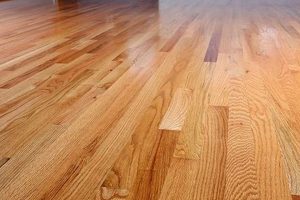
Floor finishes provide a protective layer on wooden surfaces, enhancing durability and aesthetics. Two common options offer distinct levels of sheen: one provides a low-luster, smooth appearance, often described as velvety; the other presents a more reflective, moderate shine. These differences in reflectivity significantly impact the overall look and feel of a room.
The selection of an appropriate floor finish is crucial for both practical and aesthetic reasons. The level of sheen influences the perceived cleanliness of the floor, the visibility of imperfections, and the overall brightness of the space. Historically, choice was limited, but modern advancements offer a spectrum of options tailored to specific needs and design preferences. Proper application contributes to the longevity of the flooring and enhances its resistance to wear and tear.
Understanding the nuances between these two prevalent choices involves considering factors such as light reflection, durability, and maintenance requirements. The subsequent sections will delve into a detailed comparison of these aspects, allowing for an informed decision-making process when selecting the ideal floor finish for a given application. The focus will be on contrasting the attributes to highlight their respective strengths and weaknesses.
Selecting the Optimal Floor Finish
Choosing between different levels of floor finish sheen requires careful consideration of several factors. The following tips provide guidance for making an informed decision.
Tip 1: Assess Room Lighting. A room with ample natural light may benefit from a lower sheen, mitigating glare and highlighting the flooring material. Conversely, a darker space may require a more reflective finish to enhance brightness.
Tip 2: Evaluate Traffic Levels. Higher traffic areas demand more durable finishes. Although sheen level does not directly correlate with durability, certain product formulations offering higher sheen may also incorporate enhanced protective qualities.
Tip 3: Consider Maintenance Requirements. Higher sheen finishes often require more frequent cleaning to maintain their luster and minimize the visibility of smudges and fingerprints. Lower sheen options can be more forgiving in this regard.
Tip 4: Factor in Existing Dcor. The floor finish should complement the existing aesthetic of the space. A lower sheen can create a more understated, classic look, while a higher sheen can contribute to a more modern, polished appearance.
Tip 5: Examine Subfloor Conditions. Uneven or imperfect subfloors are often less noticeable with a lower sheen finish. Highly reflective surfaces tend to accentuate imperfections.
Tip 6: Test Before Committing. Apply sample finishes to a small, inconspicuous area of the floor to evaluate the appearance under different lighting conditions and at various times of day.
Tip 7: Consult Professional Expertise. A flooring professional can provide valuable insights and recommendations based on the specific characteristics of the space and the desired outcome.
These considerations enable informed decision-making, optimizing both the aesthetic appeal and practical performance of the chosen floor finish. The final decision should align with the specific requirements of the space and the desired visual effect.
The subsequent section will delve into the broader implications of floor finish selection within the overall design context.
1. Reflectivity Difference

Reflectivity constitutes a primary distinguishing factor between satin and semi-gloss floor finishes. The degree to which a surface reflects light directly influences the perceived brightness and overall aesthetic of a space. Satin finishes, characterized by a lower light reflectance, offer a muted, velvety appearance. This subdued reflectivity diffuses light, minimizing glare and contributing to a softer, more uniform illumination within the room. Conversely, semi-gloss finishes exhibit a significantly higher reflectance, producing a noticeable sheen. This heightened reflectivity amplifies ambient light, making the space appear brighter. However, it also increases the visibility of imperfections, such as dust, scratches, and unevenness in the subfloor.
The practical implications of this reflectivity difference are substantial. Consider a room with large windows and abundant natural light. A satin finish might be preferable to avoid excessive glare and maintain a comfortable visual environment. In contrast, a dimly lit hallway could benefit from the reflective properties of a semi-gloss finish to enhance brightness and improve visibility. The choice extends to maintenance requirements. Higher reflectivity highlights dirt and smudges more readily, necessitating more frequent cleaning to preserve the desired appearance. Conversely, lower reflectivity conceals minor imperfections, making the surface appear cleaner for longer periods between cleanings. This difference influences long-term upkeep efforts and resource allocation.
In summary, the reflectivity difference between satin and semi-gloss floor finishes is a critical determinant of the space’s visual characteristics and maintenance demands. Satin’s lower reflectance offers subtle illumination and hides imperfections, while semi-gloss’s higher reflectance amplifies brightness but exposes flaws. Understanding this distinction enables informed decisions aligned with functional requirements, aesthetic preferences, and practical maintenance capabilities. The selection is a fundamental component of interior design, contributing significantly to the user experience.
2. Durability Variance
The durability of a floor finish dictates its ability to withstand wear and tear, resisting scratches, scuffs, and other forms of damage. While sheen level itself does not inherently determine durability, the composition and formulation of floor finish products significantly influence this property. Understanding the potential for “Durability Variance” is crucial when comparing different levels of sheen.
- Polyurethane Composition and Abrasion Resistance
Polyurethane-based finishes, commonly used for both satin and semi-gloss options, offer varying degrees of abrasion resistance depending on their formulation. Higher-quality polyurethanes, regardless of sheen level, generally exhibit superior durability. For instance, a water-based polyurethane, even in a semi-gloss format, may offer less protection against scratches compared to an oil-based polyurethane with a satin finish. The choice of resin and additives plays a crucial role in determining the long-term performance underfoot.
- Acrylic Fortification and Scratch Resistance
Acrylic-modified floor finishes can enhance scratch resistance. The inclusion of acrylic polymers in either satin or semi-gloss variants provides a more resilient surface. This fortification is particularly beneficial in high-traffic areas where the risk of scratching is elevated. For example, a semi-gloss finish with an acrylic component may be better suited to withstand the daily wear and tear of a busy household than a standard satin finish without such enhancement.
- Layer Thickness and Impact Resistance
The number of applied coats directly impacts a floor finish’s overall durability. Multiple layers, whether of a satin or semi-gloss product, contribute to a thicker protective barrier, increasing resistance to impacts and abrasions. A floor treated with three coats of satin polyurethane, for example, will inherently offer greater protection against damage compared to a floor with only one coat of semi-gloss. Proper application technique ensures each layer adheres effectively, maximizing its contribution to the overall durability.
- Traffic Patterns and Finish Degradation
The level of foot traffic a floor experiences directly influences the rate of finish degradation. High-traffic zones, such as hallways and entryways, typically exhibit faster wear, regardless of the chosen sheen. While a more durable finish, whether satin or semi-gloss, can mitigate this wear, regular maintenance is essential. Strategies such as the use of area rugs in high-traffic zones can help prolong the lifespan of the finish, reducing the need for frequent refinishing.
The “Durability Variance” observed between satin and semi-gloss floor finishes is primarily a function of product formulation, application technique, and traffic exposure rather than an inherent property of sheen level. While perceived hardness may differ slightly, the primary determinant of longevity rests on the quality of the chosen product and the adherence to proper application and maintenance protocols. Therefore, selection should prioritize durability ratings and specific product specifications over sheen level alone.
3. Application Difficulty

The process of applying floor finish is influenced by the product’s sheen level, resulting in varied “Application Difficulty.” Satin finishes, due to their lower reflectivity, often exhibit greater forgiveness during application. Imperfections, such as brush strokes or minor inconsistencies in the coating thickness, are less noticeable compared to semi-gloss finishes. This characteristic makes satin finishes a potentially more manageable option for less experienced individuals or DIY projects. The reduced visibility of errors reduces the likelihood of requiring corrective measures, thereby streamlining the application process.
Semi-gloss finishes, conversely, demand a higher degree of precision during application. Their increased reflectivity amplifies even slight imperfections, necessitating careful attention to detail. Proper surface preparation, including thorough sanding and cleaning, becomes critical to ensuring a smooth and even finish. Furthermore, the application technique must be meticulous to avoid streaks, overlaps, or uneven coating thicknesses, all of which are readily apparent in the final result. Specialized tools, such as high-quality applicators and controlled-environment settings, may be necessary to achieve a professional-grade outcome with semi-gloss finishes. Consider, for instance, the application of a semi-gloss polyurethane in a large, open room. Dust particles settling on the wet finish are more visible, requiring immediate removal to prevent permanent blemishes. Similarly, uneven application can result in noticeable variations in sheen across the floor’s surface, detracting from the overall aesthetic.
In conclusion, the “Application Difficulty” associated with “satin vs semi gloss floor finish” represents a significant consideration in floor finish selection. Satin finishes offer a more forgiving application process, potentially suitable for novice users or situations where time and resources are limited. Semi-gloss finishes, while capable of producing a high-luster appearance, demand a higher level of skill and attention to detail to mitigate the risk of visible imperfections. The ultimate choice hinges on the applicator’s experience, the available resources, and the desired aesthetic outcome. Ignoring these considerations risks compromising the final result and incurring additional costs for rework or professional assistance.
4. Maintenance Effort

The selection of a floor finish significantly impacts the long-term “Maintenance Effort” required to preserve its appearance and integrity. Different sheen levels exhibit varying degrees of susceptibility to visible soiling and require tailored cleaning approaches. Understanding these distinctions is crucial for informed decision-making regarding floor finish selection.
- Visibility of Scratches and Scuffs
Semi-gloss finishes, with their higher reflectivity, tend to accentuate scratches and scuffs. Surface imperfections that might be imperceptible on a satin finish become readily visible under direct or reflected light. This increased visibility necessitates more frequent cleaning and touch-up maintenance to maintain a pristine appearance. Consider a high-traffic hallway; a semi-gloss finish would likely require more frequent sweeping and spot cleaning to address visible scuff marks compared to a satin finish in the same location.
- Dust and Smudge Perception
Dust and smudges are more apparent on semi-gloss surfaces due to their reflective properties. The smooth, reflective surface allows even a thin layer of dust to scatter light, creating a dull or hazy appearance. In contrast, satin finishes diffuse light, masking minor dust accumulation. As a result, a semi-gloss floor may require more frequent dusting and mopping to eliminate visible smudges and maintain its glossy sheen. In a sunlit living room, a semi-gloss floor would require more frequent cleaning than a satin floor to avoid a dull appearance due to dust accumulation.
- Cleaning Product Compatibility
The appropriate cleaning products may vary depending on the sheen level of the floor finish. Abrasive cleaners can dull the surface of a semi-gloss finish, diminishing its reflectivity and creating a hazy appearance. Therefore, specialized cleaning solutions formulated for high-gloss surfaces are often required. Satin finishes, being less susceptible to scratching, may tolerate a wider range of cleaning products. However, harsh chemicals should still be avoided to prevent damage to the finish. Improper cleaning product usage can shorten the lifespan of either finish.
- Refinishing Frequency
Although not a routine cleaning task, the frequency with which a floor requires refinishing is influenced by the initial finish choice and the subsequent maintenance practices. Floors with semi-gloss finishes that experience heavy traffic and inadequate maintenance may require refinishing more often than satin finishes in similar conditions due to the increased visibility of wear and tear. Scratches, dullness, and loss of sheen are more noticeable on semi-gloss, prompting earlier refinishing interventions. The lifespan of either finish can be prolonged with consistent and appropriate maintenance.
In summary, the “Maintenance Effort” associated with floor finishes is directly linked to the sheen level. Semi-gloss finishes, while offering a high-luster appearance, demand more frequent and meticulous cleaning to address the increased visibility of scratches, scuffs, and dust. Satin finishes, with their lower reflectivity, offer a more forgiving surface, requiring less intensive maintenance. The choice between “satin vs semi gloss floor finish” should consider the available time, resources, and tolerance for visible imperfections.
5. Cost Implications
The selection of “satin vs semi gloss floor finish” involves a range of “Cost Implications” extending beyond the initial purchase price. While the cost per unit of floor finish may exhibit minimal variance between the two sheen levels, the overall project expenses can diverge due to several factors. Application-related costs, encompassing labor and material consumption, constitute a primary area of potential divergence. Semi-gloss finishes, demanding meticulous application to minimize visible imperfections, may necessitate professional installation, incurring higher labor costs compared to the more forgiving application of satin finishes. This difference stems from the increased skill and time required to achieve a uniform, flawless sheen with semi-gloss products. Furthermore, surface preparation for semi-gloss finishes often requires more extensive sanding and leveling to eliminate substrate imperfections that would be accentuated by the reflective surface. The need for specialized primers or sealers to ensure proper adhesion and uniform sheen further contributes to increased material costs. In contrast, satin finishes are more amenable to DIY application, potentially reducing labor expenses. However, even with DIY projects, careful consideration of material costs remains critical, as inferior application techniques can lead to increased material consumption and the need for rework, negating potential savings.
Long-term “Cost Implications” also manifest in maintenance requirements and refinishing frequency. Semi-gloss finishes, being more susceptible to visible scratches and scuffs, necessitate more frequent cleaning and maintenance to preserve their aesthetic appeal. The cost of specialized cleaning products formulated for high-gloss surfaces and the additional time invested in cleaning contribute to ongoing maintenance expenses. Furthermore, floors with semi-gloss finishes may require more frequent refinishing to address accumulated wear and tear, incurring significant costs for material and labor. Satin finishes, with their greater tolerance for imperfections and lower maintenance requirements, can offer long-term cost savings in terms of cleaning supplies and refinishing intervals. The economic impact of refinishing extends beyond direct costs. Disruption to the use of the space during the refinishing process can lead to indirect costs, particularly in commercial settings. For instance, a restaurant or retail store forced to close for refinishing will experience revenue losses that must be factored into the overall cost assessment.
In conclusion, the “Cost Implications” associated with “satin vs semi gloss floor finish” extend beyond the initial purchase price to encompass application expenses, maintenance costs, and refinishing frequency. While satin finishes may offer cost advantages through easier application and lower maintenance requirements, the ultimate decision should consider the long-term economic impact and balance it against the desired aesthetic outcome. Ignoring the comprehensive cost implications can lead to unforeseen expenses and compromise the overall value proposition of the flooring project. Careful consideration of all factors is essential for informed decision-making and effective budget management.
6. Light Sensitivity

The interaction between ambient light and floor finishes is a critical consideration in interior design. The “Light Sensitivity” of a floor finish, specifically how it reflects and diffuses light, directly influences the perceived brightness, glare, and overall aesthetic of a space, making it a crucial factor in the selection of “satin vs semi gloss floor finish”.
- Glare Reduction and Visual Comfort
Satin finishes, characterized by their matte appearance, excel at diffusing light, thereby minimizing glare. This is particularly beneficial in rooms with large windows or significant natural light sources. Excessive glare can cause eye strain and visual discomfort, making satin finishes a preferable choice in such environments. For example, a sunroom with a semi-gloss floor might experience intense glare during peak sunlight hours, whereas a satin finish would mitigate this effect, creating a more comfortable space.
- Highlighting Imperfections Under Intense Light
Semi-gloss finishes, due to their higher reflectivity, tend to amplify the visibility of imperfections in the underlying floor surface. Intense light sources, whether natural or artificial, can accentuate scratches, dents, and unevenness, diminishing the overall aesthetic appeal. In contrast, satin finishes, by diffusing light, tend to mask these imperfections. A poorly leveled subfloor, for instance, will exhibit more pronounced undulations under a semi-gloss finish than under a satin finish, especially when illuminated by a bright overhead light.
- Influence on Perceived Room Brightness
The light reflectivity of a floor finish directly impacts the perceived brightness of a room. Semi-gloss finishes, by reflecting a greater proportion of incident light, can make a space appear brighter and more spacious. This is advantageous in dimly lit areas or rooms with limited natural light. However, in already bright rooms, the increased reflectivity can result in excessive brightness and glare. The strategic use of floor finishes can compensate for lighting deficiencies or, conversely, exacerbate existing issues. A dark hallway, for example, might benefit from a semi-gloss floor to enhance brightness, while a bright living room might be better suited to a satin finish to avoid excessive glare.
- Impact on Color Perception
The way a floor finish interacts with light can influence how colors are perceived within a space. Highly reflective semi-gloss finishes can alter the perceived hue of both the floor itself and surrounding objects, potentially creating unwanted color casts or reflections. Satin finishes, with their more neutral light interaction, tend to render colors more accurately. This consideration is particularly important in spaces where precise color representation is critical, such as art galleries or showrooms. A brightly colored rug, for instance, might appear significantly different under a semi-gloss floor compared to a satin floor due to the altered light reflection.
These facets highlight the complex interplay between “Light Sensitivity” and the selection of “satin vs semi gloss floor finish”. The optimal choice depends on a careful assessment of the room’s lighting conditions, the desired aesthetic, and the tolerance for glare and visible imperfections. By understanding how different sheen levels interact with light, one can make informed decisions that enhance the overall comfort and visual appeal of the space. The strategic use of floor finishes, in this context, becomes a powerful tool in interior design, enabling the manipulation of light to achieve specific aesthetic and functional goals.
7. Aesthetic Suitability

The concept of “Aesthetic Suitability” in the context of “satin vs semi gloss floor finish” extends beyond mere preference, encompassing the harmonization of the floor’s appearance with the overall design intent of the space. This involves aligning the sheen level with the architectural style, furniture, lighting, and intended function of the room.
- Architectural Style Compatibility
The architectural style of a space often dictates the appropriate floor finish. Traditional or rustic designs frequently benefit from the understated elegance of satin finishes, which complement natural materials and muted color palettes. Modern or contemporary spaces, conversely, may lend themselves to the sleek and polished appearance of semi-gloss finishes, which enhance minimalist aesthetics and reflect light to create a sense of spaciousness. Consider a Victorian-era home, where a satin finish on hardwood floors would preserve the historical character, versus a modern loft, where a semi-gloss finish could accentuate the clean lines and open layout.
- Furniture and Dcor Harmony
The floor finish should complement the furniture and dcor within the space. Highly reflective semi-gloss floors can enhance the visual impact of modern furniture with metallic accents and glossy surfaces. Satin finishes, with their subtle sheen, provide a neutral backdrop for more ornate or textured furniture, preventing visual overload. The decision hinges on creating a cohesive and balanced aesthetic. For instance, a room with plush, velvet upholstery and antique furnishings would likely benefit from the subdued elegance of a satin floor, whereas a room with sleek, minimalist furniture might be enhanced by the reflective qualities of a semi-gloss finish.
- Functional Space Considerations
The intended function of a room influences the aesthetic suitability of floor finishes. Formal living rooms or dining rooms often benefit from the sophisticated appearance of semi-gloss floors, conveying a sense of elegance and refinement. High-traffic areas, such as hallways or kitchens, may be better suited to the practicality and understated charm of satin finishes, which conceal wear and tear more effectively. A ballroom, designed for formal events, might feature a semi-gloss floor to enhance the ambiance, while a busy family kitchen might prioritize the durability and lower maintenance of a satin finish.
- Lighting Integration
The interplay between lighting and floor finish is crucial for achieving a harmonious aesthetic. Semi-gloss finishes, with their reflective properties, can amplify ambient light, making a space appear brighter. However, they can also create glare if not carefully managed. Satin finishes, which diffuse light, offer a softer, more muted illumination, reducing glare and creating a more comfortable visual environment. A dimly lit basement might benefit from the light-enhancing properties of a semi-gloss floor, while a sun-drenched living room might require the glare-reducing qualities of a satin finish to maintain visual comfort.
These considerations highlight the multifaceted nature of “Aesthetic Suitability” in the context of “satin vs semi gloss floor finish”. The optimal choice hinges on achieving a cohesive and balanced visual effect that aligns with the architectural style, furniture, lighting, and intended function of the space. By carefully evaluating these factors, one can select a floor finish that not only enhances the aesthetic appeal of the room but also contributes to its overall functionality and comfort.
Frequently Asked Questions
This section addresses common inquiries regarding the selection and application of satin and semi-gloss floor finishes, providing clarity on their respective attributes and suitability for various applications.
Question 1: Is one finish inherently more durable than the other?
Durability is not solely determined by sheen level. The composition of the finish, including the type of resin and the presence of additives, plays a more significant role. High-quality formulations, regardless of sheen, will offer superior resistance to scratches and wear. Verify the product specifications and durability ratings before making a selection.
Question 2: Does sheen level affect the visibility of imperfections?
Yes, semi-gloss finishes, due to their higher reflectivity, tend to amplify the visibility of imperfections such as scratches, dents, and unevenness in the subfloor. Satin finishes, with their lower reflectivity, are more forgiving and tend to conceal minor flaws.
Question 3: Which finish is easier to apply for a DIY project?
Satin finishes are generally considered easier to apply for DIY projects. Their lower reflectivity makes them more forgiving, minimizing the visibility of brush strokes and minor inconsistencies in the coating. Semi-gloss finishes demand greater precision and skill to avoid streaks and uneven sheen.
Question 4: What type of maintenance is required for each finish?
Semi-gloss finishes require more frequent cleaning to maintain their luster and minimize the visibility of dust, smudges, and scratches. Specialized cleaning products formulated for high-gloss surfaces are often recommended. Satin finishes require less frequent cleaning and are more tolerant of a wider range of cleaning products.
Question 5: Does sheen level affect the cost of the floor finish project?
While the unit cost of the finish itself may be similar, the overall project cost can vary. Semi-gloss finishes may necessitate professional installation due to their demanding application requirements, increasing labor costs. Satin finishes, being more DIY-friendly, can potentially reduce labor expenses.
Question 6: Which finish is better for a room with a lot of natural light?
Satin finishes are often preferable in rooms with ample natural light as they diffuse light and minimize glare. Semi-gloss finishes can create excessive glare in brightly lit rooms, potentially causing eye strain and visual discomfort.
Understanding these distinctions will enable a more informed decision-making process, ensuring the selected floor finish aligns with both aesthetic preferences and practical requirements.
The following section offers a comparative summary of “satin vs semi gloss floor finish” properties.
Conclusion
The exploration of “satin vs semi gloss floor finish” reveals distinct characteristics with significant implications for both aesthetics and practicality. Sheen level influences reflectivity, durability, application difficulty, maintenance effort, cost, light sensitivity, and overall aesthetic suitability. The attributes are crucial for informed decision-making within the context of floor finish selection. A nuanced understanding of these differentiators facilitates the alignment of flooring solutions with specific project requirements and desired outcomes.
Strategic selection necessitates a comprehensive evaluation of the interplay between sheen level and the intended environment. The ultimate decision should be guided by a commitment to balancing visual appeal with functional performance, ensuring long-term satisfaction and value. Ongoing assessment of available technologies and evolving aesthetic trends remains essential for optimizing flooring solutions in dynamic environments. This informed approach contributes to the creation of spaces that are both visually appealing and practically sound.