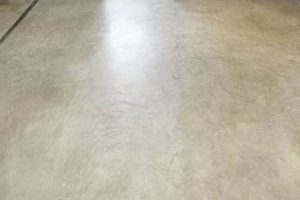
A cementitious mixture that flows easily to create a level and smooth surface, often utilized as a final walking surface. This material is designed to spread and settle uniformly, eliminating the need for extensive manual leveling. As an example, it can be applied over existing concrete slabs in residential or commercial settings to create a modern, minimalist aesthetic.
The application of this surfacing method provides numerous advantages, including a seamless appearance, durability, and ease of maintenance. Historically, achieving perfectly level floors was a labor-intensive process. This modern approach reduces installation time and can enhance the value and appeal of interior spaces. Its resilience makes it suitable for high-traffic areas, and its smooth surface simplifies cleaning.
This article will delve into preparation techniques, application methods, design considerations, maintenance procedures, and potential challenges associated with utilizing this material for interior spaces. Understanding these aspects is essential for achieving optimal results and ensuring the long-term performance of this flooring solution.
Essential Considerations for Self Leveling Concrete as Finished Floor
Achieving a successful outcome with cementitious self-leveling materials as a final floor requires careful planning and meticulous execution. The following tips address critical aspects to ensure optimal performance and aesthetic results.
Tip 1: Substrate Preparation is Paramount: Thoroughly clean the existing substrate, removing all debris, grease, and coatings. Proper preparation includes mechanically profiling the surface to ensure adequate bonding of the self-leveling material. Failure to properly prepare the substrate can result in delamination or cracking.
Tip 2: Priming is Non-Negotiable: Apply a compatible primer according to the manufacturer’s specifications. Priming seals the substrate, prevents air bubbles from rising to the surface of the self-leveling material, and promotes adhesion. Skipping or improperly applying the primer can compromise the integrity of the finished floor.
Tip 3: Accurate Mixing is Critical: Adhere strictly to the manufacturer’s instructions for mixing the self-leveling concrete. Use the correct amount of water and mix for the specified duration. Over-watering can weaken the material, while under-watering can hinder flow and self-leveling properties.
Tip 4: Proper Pouring Technique is Essential: Pour the self-leveling concrete continuously and evenly, maintaining a consistent flow rate. Use a gauge rake or pin leveler to assist in achieving the desired thickness and to remove any trapped air. An inconsistent pour can result in variations in surface level and appearance.
Tip 5: Control Environmental Conditions: Maintain consistent temperature and humidity levels during the application and curing process. Extreme temperatures or humidity fluctuations can affect the setting time and strength of the self-leveling concrete. Consult the manufacturer’s recommendations for optimal environmental conditions.
Tip 6: Curing is Crucial for Durability: Allow the self-leveling concrete to cure fully, according to the manufacturer’s instructions. Protect the surface from foot traffic and other disturbances during the curing period. Premature use can damage the uncured material and compromise its long-term performance.
Tip 7: Consider a Protective Sealer: Apply a high-quality sealer specifically designed for cementitious surfaces to protect the finished floor from staining, abrasion, and moisture penetration. The sealer can also enhance the appearance and longevity of the floor. Select a sealer appropriate for the intended use and aesthetic desired.
By adhering to these guidelines, stakeholders can maximize the potential of self-leveling concrete as a finished flooring solution, achieving a durable, aesthetically pleasing, and long-lasting surface.
The following sections will further explore the specific applications and design considerations involved in utilizing this versatile flooring material.
1. Surface Preparation

Surface preparation is a foundational element in achieving a successful self-leveling concrete finished floor. Its impact on the longevity, aesthetics, and overall performance of the flooring system cannot be overstated. Proper preparation ensures adequate bonding between the self-leveling concrete and the existing substrate, preventing delamination and other failures.
- Removal of Contaminants
The existing surface must be thoroughly cleaned to remove all contaminants, including dust, dirt, grease, oil, paint, coatings, and any loose or unsound materials. Contaminants impede the bond between the self-leveling concrete and the substrate. For example, failure to remove a pre-existing wax coating from a concrete floor will inevitably result in delamination of the new surface. Proper removal often involves mechanical methods like grinding, shot blasting, or scarifying.
- Profiling the Surface
Creating a mechanical profile on the existing surface is essential for optimal adhesion. This involves roughening the surface to increase the surface area for bonding. Common methods include grinding with diamond tooling or shot blasting. The specific profile required depends on the type of self-leveling concrete used and the manufacturer’s recommendations. Without a proper profile, the bond strength will be insufficient, leading to potential cracking or separation.
- Repairing Substrate Damage
Any cracks, holes, or other damage to the existing substrate must be repaired prior to applying the self-leveling concrete. These imperfections can weaken the bond and potentially telegraph through the new floor surface. Repair materials, such as epoxy patching compounds, should be compatible with both the substrate and the self-leveling concrete. Ignoring pre-existing damage can compromise the structural integrity of the entire flooring system.
- Ensuring Substrate Stability
The existing substrate must be structurally sound and stable. Any movement or instability in the substrate will transfer to the self-leveling concrete, causing cracking or other damage. Addressing any underlying structural issues before applying the self-leveling concrete is crucial. For example, a settling foundation must be stabilized before installing a self-leveling concrete floor.
In summary, surface preparation directly influences the performance of self-leveling concrete as a finished floor. Neglecting any aspect of this crucial step increases the risk of failure. Rigorous cleaning, profiling, repair, and stability checks create the necessary foundation for a durable and aesthetically pleasing finished surface. Consider the example of a commercial space where heavy machinery operates; proper surface preparation is paramount to prevent premature wear and tear.
2. Mix Ratio Accuracy
The precise proportioning of components in self-leveling concrete is critical for achieving the desired performance characteristics in a finished floor. Deviations from specified mix ratios can significantly impact the material’s flow, strength, and long-term durability, ultimately affecting the overall success of the flooring application.
- Flowability and Leveling Properties
The water-to-cement ratio directly influences the flowability of the self-leveling concrete. An excessive amount of water reduces viscosity, leading to segregation of aggregates and reduced strength. Conversely, insufficient water hinders flow, impeding the material’s ability to self-level effectively. The result may be an uneven surface requiring additional labor and material to correct. Consider the scenario of a large commercial space where precise leveling is crucial; incorrect ratios would compromise the seamlessness of the finished floor.
- Strength and Durability
Maintaining the correct proportion of cement and aggregates is vital for achieving the specified compressive strength and abrasion resistance. An improper ratio can weaken the concrete matrix, making the floor susceptible to cracking, dusting, and premature wear. For instance, in a high-traffic retail environment, inadequate strength due to incorrect mixing would result in rapid deterioration of the floor surface.
- Curing Characteristics
Accurate mix ratios are integral to the concrete’s hydration process and subsequent curing. Deviations can lead to inconsistent curing rates, affecting the overall strength and durability of the floor. Differential curing can also introduce internal stresses, increasing the likelihood of cracking. Consider a scenario where part of a floor receives sunlight more than another part, causing uneven drying that is exacerbated by an imperfect mixture. This can compromise the structural integrity of the self-leveling concrete as a finished floor.
- Bonding Performance
An appropriately proportioned mix enhances the concrete’s ability to bond effectively with the substrate and any subsequent coatings or sealers. Incorrect ratios can result in a weaker bond, leading to delamination or separation of the layers. Imagine a case where a sealant meant to protect the finished self-leveling concrete begins to peel away shortly after its application because the underlying concrete wasn’t properly mixed to ensure ideal bonding.
In summary, meticulous adherence to specified mix ratios is non-negotiable for successful self-leveling concrete finished floors. Achieving optimal performance and longevity requires precise control over the composition of the material, ensuring it possesses the necessary flowability, strength, curing characteristics, and bonding properties to withstand intended use and environmental conditions. Ignoring the importance of accurate mixing can lead to costly failures and compromise the intended aesthetic and functional benefits.
3. Pouring Consistency

Pouring consistency is a crucial determinant in the successful application of self-leveling concrete as a finished floor. Maintaining a consistent flow and rate during the pouring process directly impacts the final surface quality, uniformity, and structural integrity of the installation.
- Maintaining a Continuous Flow
Interruptions during the pouring process can result in visible seams or lines in the finished surface. These discontinuities occur because the self-leveling concrete begins to set at slightly different times, creating a less homogeneous appearance. A continuous, uninterrupted pour ensures a seamless and aesthetically pleasing surface. For example, in a large open-plan space, breaks in the pour can lead to noticeable variations in color or texture across the floor.
- Controlling the Flow Rate
Variations in the flow rate can lead to inconsistencies in the thickness of the self-leveling concrete layer. Too rapid of a pour might result in areas where the material spreads too thinly, while a slow pour can create localized build-ups. Maintaining a consistent flow rate ensures that the material spreads evenly, achieving the desired thickness across the entire surface. This is particularly important in areas where precise leveling is required, such as around drains or doorways.
- Managing the Working Time
Self-leveling concrete has a limited working time before it begins to set. A consistent pouring rate ensures that the material is placed and spread before it starts to harden, allowing for optimal leveling and surface finish. If the pour is too slow, the material may begin to set before it can fully level, resulting in an uneven or textured surface. This is a critical consideration in warmer climates where setting times may be accelerated.
- Minimizing Air Entrapment
Inconsistent pouring techniques can increase the likelihood of air entrapment within the self-leveling concrete. Trapped air can create bubbles or voids on the surface, compromising both the aesthetics and the structural integrity of the floor. A smooth, consistent pour helps to minimize air entrapment and ensure a dense, solid floor. Using appropriate tools, such as a gauge rake or pin leveler, during the pouring process further assists in releasing trapped air.
Therefore, consistent pouring is integral to the successful utilization of self-leveling concrete as a finished floor. A continuous flow, controlled rate, management of working time, and minimization of air entrapment contribute directly to the creation of a durable, level, and aesthetically pleasing surface. These factors are all interconnected and crucial to the overall performance of the flooring system.
4. Curing Duration

The curing duration is a critical phase in the successful installation of self-leveling concrete as a finished floor. This period dictates the development of strength, hardness, and overall durability, ultimately determining the longevity and performance of the flooring system.
- Hydration and Strength Development
The chemical process of hydration, where cement particles react with water to form a hardened matrix, requires adequate time to complete. Insufficient curing duration impedes hydration, resulting in a weaker, less durable concrete floor. For instance, premature foot traffic on a floor not allowed to cure adequately can lead to surface damage and reduced abrasion resistance. Manufacturers guidelines provide the necessary duration for full hydration to ensure desired strength is achieved.
- Moisture Control and Volume Stability
Curing duration affects moisture content within the concrete. Proper curing allows for controlled evaporation of excess water, minimizing shrinkage and cracking. Rapid drying, caused by insufficient curing, can lead to surface crazing and reduced structural integrity. For instance, self-leveling concrete applied in a dry climate requires extended curing to prevent premature moisture loss and subsequent cracking. Applying curing compounds or covering the surface helps to retain moisture during this period.
- Surface Hardness and Abrasion Resistance
The length of the curing period directly impacts the surface hardness and abrasion resistance of the finished floor. Longer curing times allow for a denser, more durable surface that is better able to withstand wear and tear. Premature exposure to heavy traffic or abrasive elements can damage the uncured surface, compromising its long-term performance. A well-cured floor is significantly more resistant to scratching, scuffing, and other forms of surface damage.
- Bonding and Adhesion with Coatings
Complete curing ensures that the self-leveling concrete is properly prepared to receive any subsequent coatings or sealers. The surface must be fully cured to achieve optimal bonding, preventing delamination or peeling of the applied coatings. Applying a sealer to an inadequately cured surface can trap moisture, leading to blistering and adhesion failure. Manufacturers of coatings often specify the minimum curing time required before their products can be applied.
In conclusion, adherence to recommended curing durations is paramount for achieving a durable, aesthetically pleasing, and long-lasting self-leveling concrete finished floor. Failure to allow sufficient curing time can compromise the material’s strength, moisture stability, surface hardness, and ability to bond with subsequent coatings, ultimately leading to costly repairs and premature floor failure.
5. Sealer selection

The appropriate sealer selection is paramount to the success of self-leveling concrete as a finished floor. The porous nature of concrete necessitates a protective barrier against staining, moisture penetration, and abrasion. The choice of sealer directly impacts the floor’s aesthetic appearance, ease of maintenance, and longevity. Without a properly selected sealer, the exposed concrete is vulnerable to environmental factors and daily wear, potentially leading to irreversible damage and costly repairs. For example, in a restaurant setting, an unsealed concrete floor is susceptible to oil and food stains, which are difficult or impossible to remove, permanently detracting from the floor’s appearance.
Different types of sealers offer varying levels of protection and aesthetic qualities. Penetrating sealers, such as silicates and siloxanes, impregnate the concrete, providing water repellency without altering the surface appearance significantly. These are ideal for maintaining a natural concrete look while protecting against moisture damage. Film-forming sealers, such as acrylics and epoxies, create a protective layer on top of the concrete, offering enhanced stain and abrasion resistance. These can also alter the floor’s finish, providing a glossy or matte appearance. Selecting the right sealer requires careful consideration of the intended use of the space, the desired aesthetic, and the level of protection required. For instance, a high-traffic retail store might benefit from a durable epoxy sealer, while a residential living room might be better suited to a penetrating sealer that preserves the concrete’s natural texture. Understanding the properties and limitations of each type of sealer is crucial for making an informed decision.
Ultimately, the selection of an appropriate sealer is an integral step in the process of utilizing self-leveling concrete as a finished floor. It is not merely an aesthetic choice but a functional necessity that protects the investment and ensures the long-term performance of the flooring system. By carefully considering the specific needs of the space and the characteristics of available sealers, stakeholders can maximize the benefits of this versatile flooring solution.
6. Substrate adhesion
Substrate adhesion constitutes a fundamental requirement for the successful implementation of self-leveling concrete as a finished floor. Inadequate adhesion between the self-leveling material and the underlying substrate invariably leads to premature failure, characterized by delamination, cracking, and compromised structural integrity. The self-leveling concrete, regardless of its inherent strength or aesthetic appeal, is ultimately reliant on a robust bond to the substrate for load bearing and longevity. Consider the example of a self-leveling concrete floor installed over a poorly prepared substrate contaminated with oil residue; the resulting lack of adhesion will quickly manifest as localized cracking and separation from the substrate under normal foot traffic.
The process of achieving optimal substrate adhesion involves several critical steps, including thorough cleaning, mechanical profiling, and the application of a compatible primer. Cleaning removes contaminants that impede bonding, while mechanical profiling creates a textured surface that increases the surface area for adhesion. Primers act as an intermediary layer, enhancing the chemical bond between the substrate and the self-leveling concrete. In practical applications, varying substrate materials (e.g., existing concrete, wood, tile) require different preparation techniques and primer selections to ensure compatibility and adequate adhesion. For instance, a porous concrete substrate may require a penetrating primer, whereas a non-porous tile surface may necessitate a bonding agent with increased adhesive properties. Proper substrate preparation is not merely a preliminary step but an integral component of the self-leveling concrete flooring system.
In summary, substrate adhesion directly determines the performance and lifespan of a self-leveling concrete finished floor. Neglecting this critical aspect, even with high-quality self-leveling materials, inevitably leads to compromised results. Challenges in achieving adequate adhesion often stem from improper surface preparation, incompatible materials, or environmental factors that interfere with the bonding process. A comprehensive understanding of substrate properties, preparation techniques, and appropriate material selection is essential for ensuring the successful and durable application of self-leveling concrete as a finished floor.
7. Ambient conditions
Ambient conditions exert a significant influence on the properties and performance of self-leveling concrete when utilized as a finished floor. Temperature, humidity, and air movement during application and curing directly impact the material’s flowability, setting time, strength development, and susceptibility to surface defects. Control and monitoring of these environmental factors are essential for achieving optimal results.
- Temperature Effects on Flow and Set Time
Elevated temperatures accelerate the hydration process, reducing the working time of the self-leveling concrete and potentially leading to rapid setting before proper leveling can occur. Conversely, low temperatures retard hydration, extending the setting time and increasing the risk of surface carbonation. For example, applying self-leveling concrete in direct sunlight on a hot day may result in premature surface crusting and poor flow characteristics. Maintaining a consistent temperature within the manufacturer’s recommended range is crucial for achieving a level and uniform surface.
- Humidity’s Impact on Curing
Relative humidity levels influence the rate of moisture evaporation from the self-leveling concrete during the curing process. Low humidity promotes rapid drying, increasing the potential for shrinkage cracking and surface crazing. High humidity can impede evaporation, slowing down the curing process and potentially leading to reduced strength. A balanced humidity level is necessary to ensure gradual and uniform curing. Controlled humidity environments, achieved through the use of humidifiers or dehumidifiers, can mitigate these risks.
- Air Movement and Surface Defects
Excessive air movement across the surface of freshly poured self-leveling concrete can accelerate surface drying, leading to plastic shrinkage cracks and other surface defects. Drafts from open windows or ventilation systems can create uneven drying patterns, resulting in variations in color and texture. Shielding the surface from direct air movement during the initial setting period can minimize these issues. Controlled ventilation, avoiding direct drafts, is recommended during the curing phase.
- Substrate Temperature Considerations
The temperature of the existing substrate to which the self-leveling concrete is applied also plays a crucial role. If the substrate is significantly colder or warmer than the self-leveling concrete, it can affect the material’s flow and bonding characteristics. Applying self-leveling concrete to a cold concrete slab can slow down the hydration process at the interface, potentially weakening the bond. Pre-heating or pre-cooling the substrate, when necessary, can help to equalize temperature differences and promote optimal adhesion.
In conclusion, ambient conditions exert a complex and interconnected influence on the performance of self-leveling concrete as a finished floor. Diligent monitoring and control of temperature, humidity, air movement, and substrate temperature are essential for mitigating potential risks and achieving a durable, aesthetically pleasing, and long-lasting flooring solution. Deviations from ideal conditions can compromise the material’s properties and lead to costly repairs.
Frequently Asked Questions
This section addresses common inquiries regarding the utilization of self-leveling concrete as a finished flooring surface. The responses aim to provide clarity and dispel misconceptions about this material and its application.
Question 1: Is self-leveling concrete truly self-leveling, or does it require manual assistance?
Self-leveling concrete is designed to flow and spread evenly with minimal manual intervention. However, it typically requires the use of a gauge rake or pin leveler to assist in achieving the desired thickness and to remove any trapped air. It is not entirely self-acting and requires skilled application.
Question 2: Can self-leveling concrete be applied over any existing flooring material?
Self-leveling concrete can be applied over various substrates, including existing concrete, wood, and tile. However, thorough surface preparation is essential. The existing surface must be clean, structurally sound, and properly primed to ensure adequate adhesion. Some substrates may require specialized primers or bonding agents.
Question 3: What is the typical thickness range for self-leveling concrete as a finished floor?
The recommended thickness typically ranges from 1/4 inch to 1 inch, depending on the specific product and the condition of the substrate. Thicker applications may be necessary to correct significant unevenness or to achieve a desired aesthetic effect. Consult the manufacturer’s specifications for recommended thickness guidelines.
Question 4: How long does self-leveling concrete take to dry and cure before it can be walked on?
Drying and curing times vary depending on factors such as ambient temperature, humidity, and the specific product used. Generally, the surface can be lightly walked on within 24-48 hours. However, full curing and hardening may take several days to weeks. Consult the manufacturer’s guidelines for specific curing recommendations.
Question 5: Is self-leveling concrete as a finished floor susceptible to staining and damage?
Unsealed self-leveling concrete is porous and susceptible to staining and abrasion. The application of a protective sealer is highly recommended to enhance stain resistance, improve durability, and prolong the lifespan of the floor. The choice of sealer should be appropriate for the intended use and traffic level.
Question 6: Can self-leveling concrete be colored or stained to achieve a desired aesthetic?
Self-leveling concrete can be colored using integral pigments or surface stains. Integral pigments are added to the mix before application, providing a consistent color throughout the material. Surface stains are applied after the concrete has cured, allowing for more varied and decorative effects. Proper preparation and sealing are essential for achieving optimal color and stain retention.
These answers provide a foundational understanding of key considerations when utilizing self-leveling concrete as a finished floor. Careful planning and execution are critical for achieving desired results.
The following section will explore specific design applications and creative possibilities offered by this versatile flooring material.
Conclusion
This exploration of self leveling concrete as finished floor highlighted several critical aspects. From meticulous surface preparation and precise mixing ratios to consistent pouring techniques and proper curing durations, each step significantly impacts the final outcome. The selection of an appropriate sealer, ensuring adequate substrate adhesion, and controlling ambient conditions are also essential for long-term performance. The successful implementation of this flooring solution requires a comprehensive understanding of these factors and adherence to industry best practices.
The information presented underscores the importance of informed decision-making when considering self leveling concrete as a finished flooring option. A thorough assessment of project requirements, material properties, and installation procedures is crucial for achieving a durable, aesthetically pleasing, and cost-effective result. Continued advancements in material science and application techniques promise to further enhance the versatility and appeal of this flooring solution in the future.